
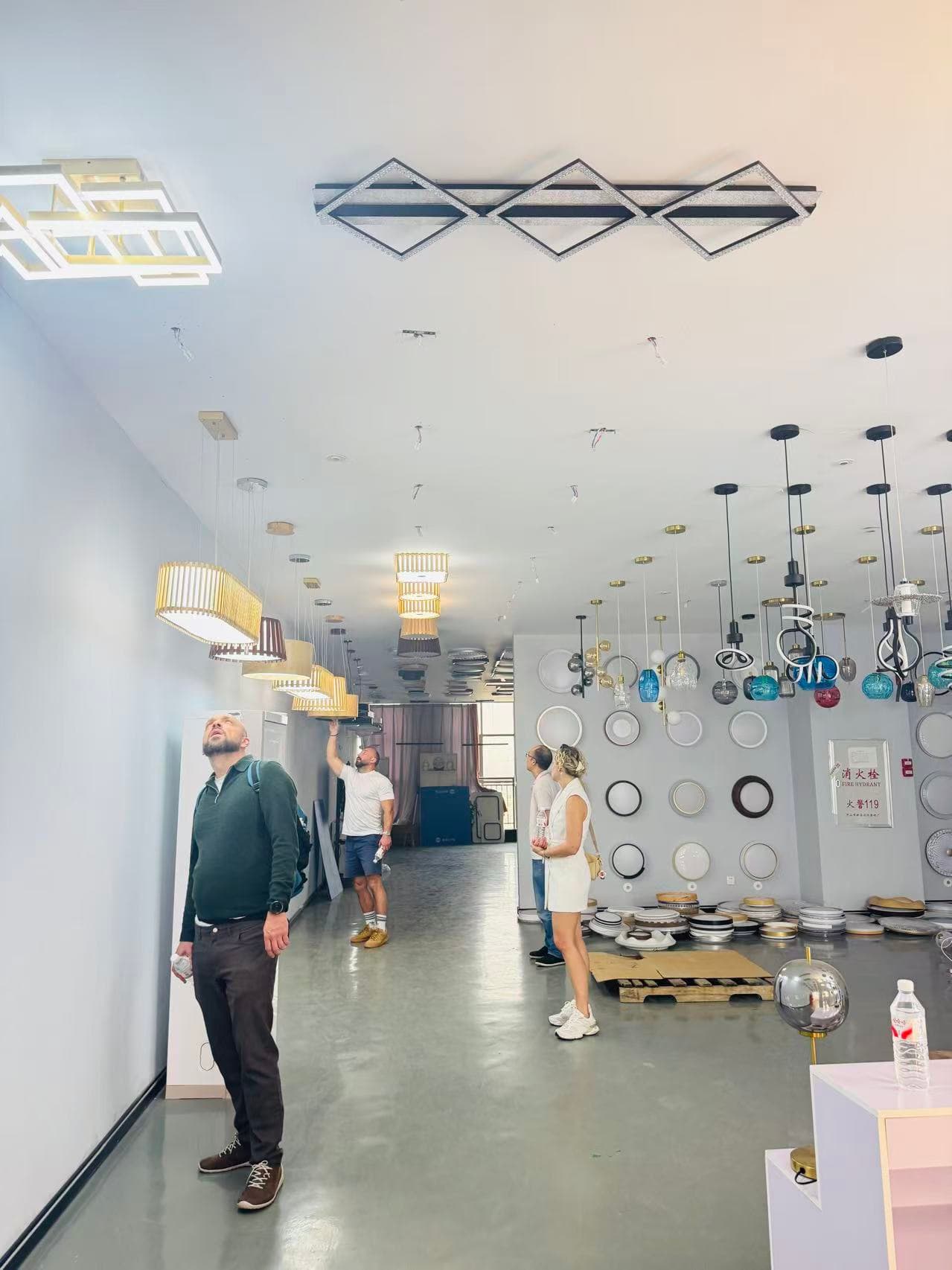
Wholesale Lighting Sourcing Checklist for Distributors
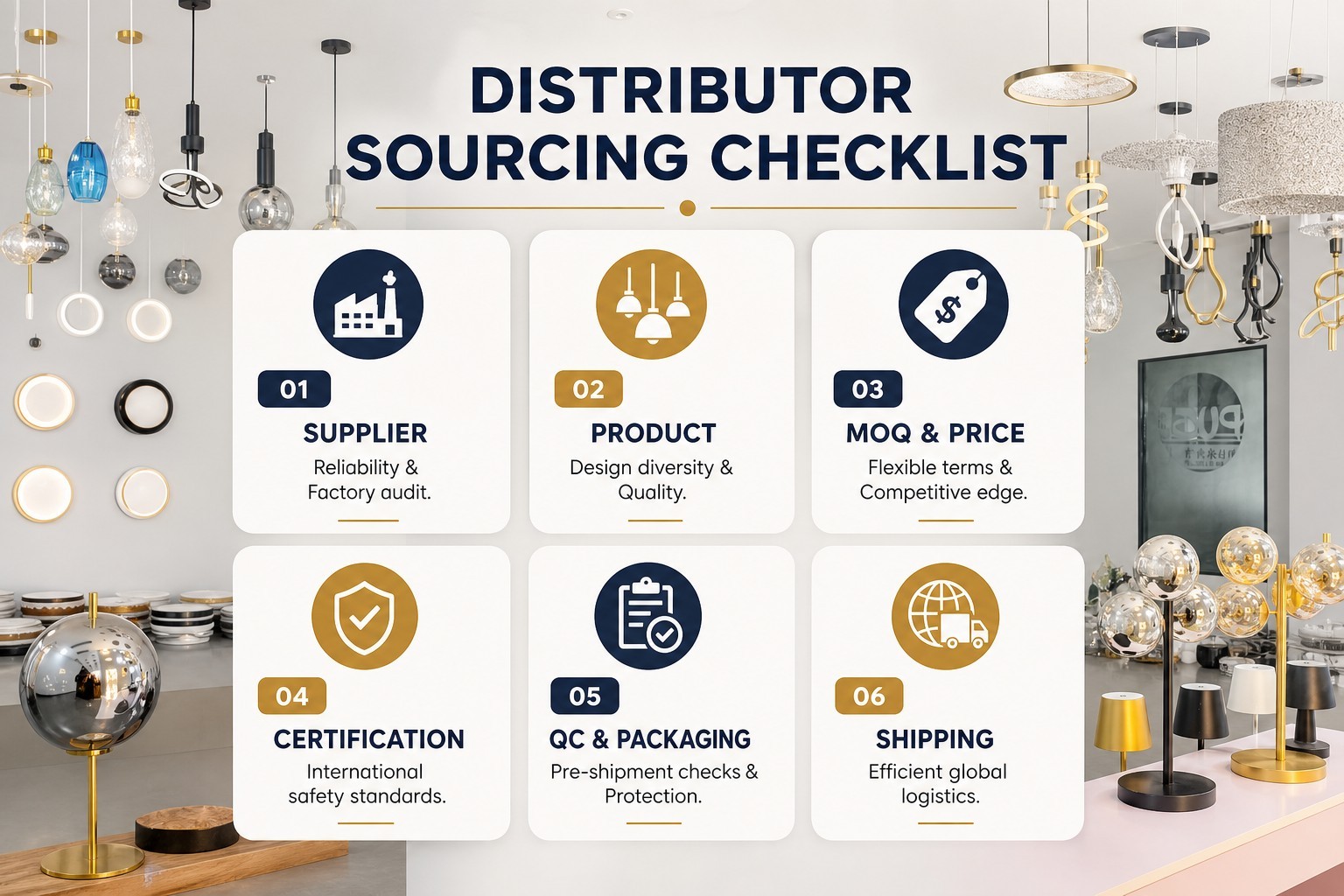
A good wholesale lighting sourcing process starts with evaluating the supplier, product quality, pricing, MOQ, certifications, customization capabilities, and logistics before placing a bulk order.
For lighting distributors, choosing the right supplier is about more than finding the lowest price. A reliable supplier should be able to provide consistent product quality, clear specifications, reasonable MOQs, appropriate certifications, stable production, and dependable delivery.
This checklist covers the key points distributors should review before selecting a wholesale lighting supplier.
1. Define Your Lighting Product Requirements
Before contacting suppliers, clearly define what you want to source.
Product Category
☐ Pendant lights
☐ Wall lights
☐ Ceiling lights
☐ Table lamps
☐ Floor lamps
☐ Mirror lights
☐ Chandeliers
☐ Other lighting products
Product Specifications
☐ Product dimensions
☐ Materials
☐ Colors and finishes
☐ Wattage
☐ Voltage
☐ Color temperature
☐ Lumens
☐ CRI
☐ Dimming requirements
☐ Light source
☐ Installation method
Tip: The more specific your initial requirements are, the easier it is to compare supplier quotations accurately.
2. Check the Lighting Supplier
A distributor should evaluate the supplier before focusing only on individual products.
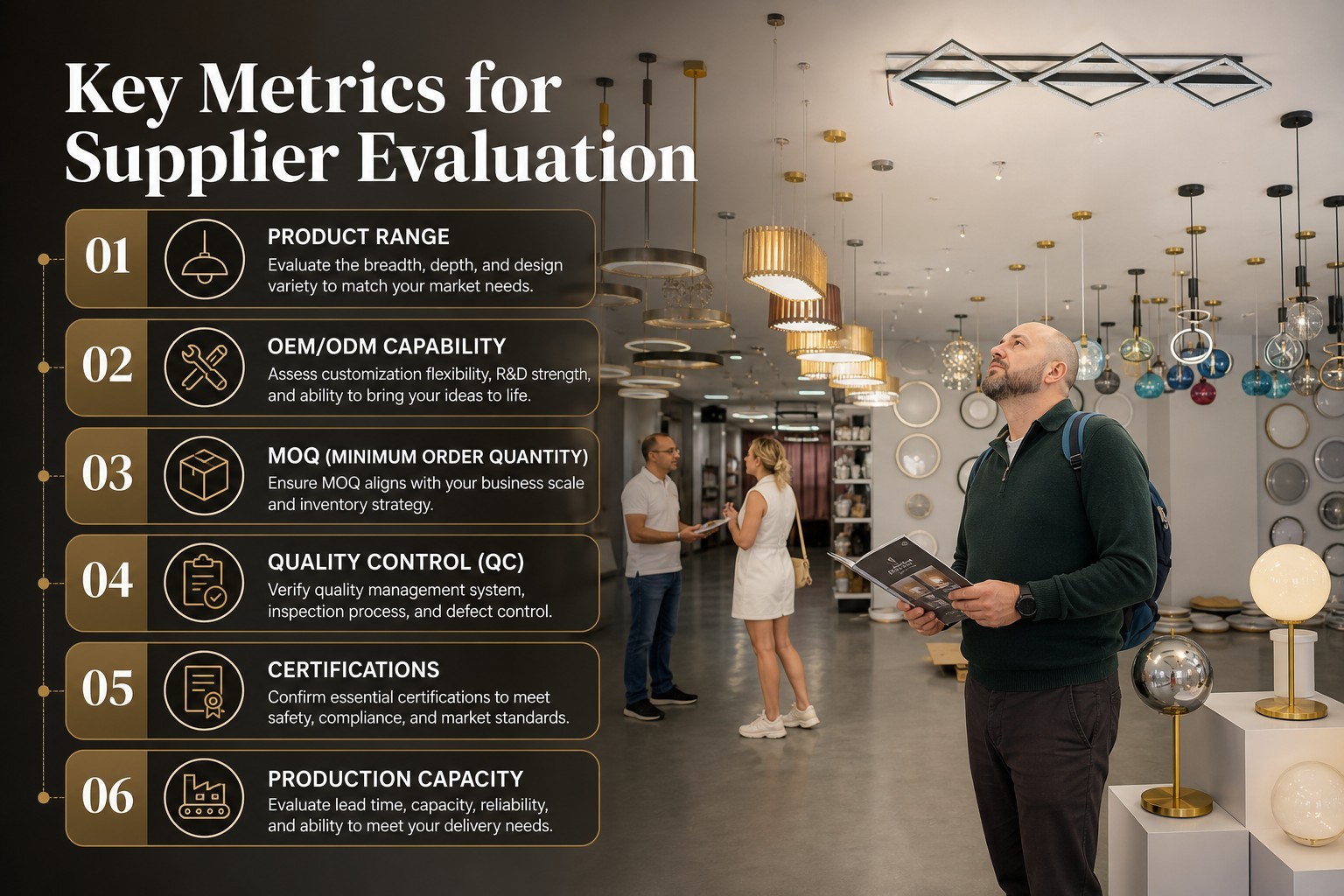
Supplier Evaluation Checklist
☐ Manufacturer or trading company identified
☐ Product range matches your business
☐ Relevant manufacturing experience
☐ Export experience
☐ OEM/ODM capability
☐ Private-label capability
☐ Quality-control process
☐ Sample service
☐ Production capacity
☐ Customer communication
☐ After-sales support
Ask the supplier:
What types of lighting products do you manufacture, and what markets do you currently supply?
A supplier with experience in international B2B lighting can often better understand product specifications, packaging, compliance, and export requirements.
3. Review the Product Catalog
Do not evaluate a supplier based on one product alone if you plan to build a broader product range.
Check:
☐ Number of lighting categories
☐ Product design range
☐ Modern lighting
☐ Decorative lighting
☐ Residential lighting
☐ Commercial lighting
☐ New product development
☐ Custom product capability
☐ Product consistency across categories
For distributors, working with a supplier that offers multiple complementary lighting categories can simplify sourcing and reduce the number of suppliers you need to manage.
4. Request Samples
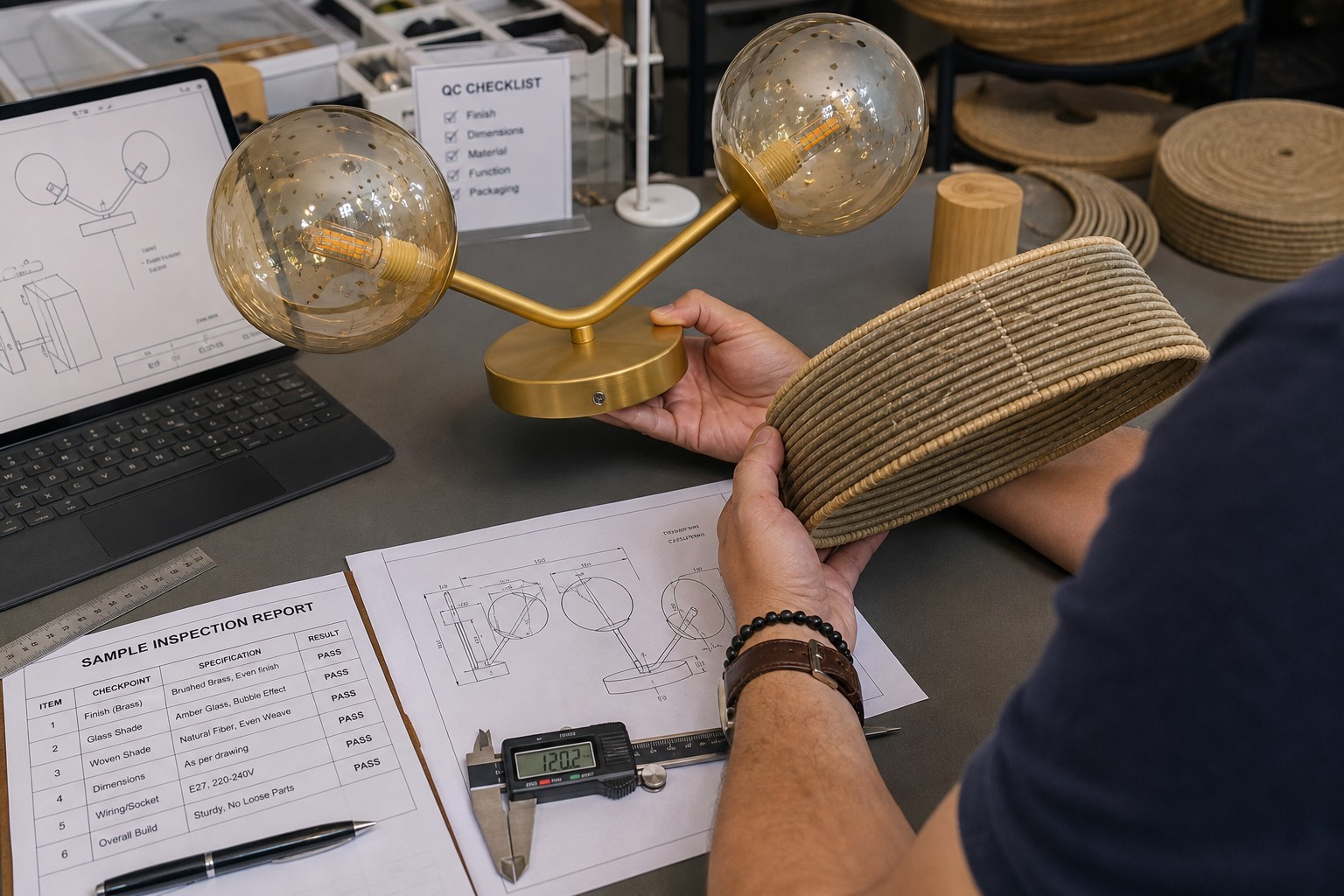
Always evaluate samples before committing to a significant bulk order whenever practical.
Check the sample for:
☐ Product appearance
☐ Dimensions
☐ Materials
☐ Surface finish
☐ Color consistency
☐ Assembly quality
☐ Electrical components
☐ Light output
☐ Color temperature
☐ Installation method
☐ Accessories
☐ Packaging
The sample should be treated as a reference for the final production order.
For OEM/ODM projects, request a final pre-production sample before mass production.
5. Check MOQ
MOQ means Minimum Order Quantity.
Ask:
☐ What is the MOQ for each product?
☐ Can different models be mixed?
☐ Can different colors be mixed?
☐ Is MOQ calculated separately by finish?
☐ Is there a minimum order value?
☐ Is the MOQ different for OEM/ODM products?
☐ Is private-label packaging subject to a separate MOQ?
☐ Can I place a smaller trial order?
Do not compare suppliers based on MOQ alone. A lower MOQ may come with a higher unit price.
6. Compare Wholesale Pricing
Request a detailed quotation rather than only asking:
"What is your best price?"
Ask suppliers to clarify:
☐ Unit price
☐ Quantity tier pricing
☐ Sample price
☐ Packaging cost
☐ Customization cost
☐ Tooling cost
☐ Labeling cost
☐ Shipping terms
☐ Payment terms
☐ Price validity
Also ask whether the price changes at different order quantities.
For example:
100 pcs → Price A
500 pcs → Price B
1,000 pcs → Price C
This helps distributors calculate their expected margins and determine the most efficient purchasing quantity.
7. Check Lighting Certifications and Compliance
Confirm that the products meet the requirements of your target market before placing the bulk order.
Depending on the destination market and product, relevant requirements may include:
☐ CE
☐ RoHS
☐ ETL
☐ UL
☐ UKCA
☐ Other applicable standards
Ask the supplier:
Can you provide compliance or certification documentation for the specific lighting model I plan to purchase?
Do not assume that a certification applies to every product manufactured by the same supplier.
The product configuration and documentation should be checked carefully.
8. Evaluate Product Quality Control
A reliable lighting supplier should have a defined quality-control process.
Ask:
☐ Is incoming material inspected?
☐ Are components checked before assembly?
☐ Is production monitored?
☐ Are finished products inspected?
☐ Is electrical performance tested?
☐ Is packaging inspected?
☐ Can inspection reports be provided?
☐ Can the supplier follow a buyer-specific QC checklist?
For larger orders, consider inspection at different stages:
Pre-Production → During Production → Pre-Shipment
9. Confirm Product Specifications in Writing
Important product requirements should not depend only on conversations or messages.
Create a written specification sheet covering:
☐ Model number
☐ Dimensions
☐ Materials
☐ Color
☐ Finish
☐ Voltage
☐ Wattage
☐ CCT
☐ CRI
☐ Driver
☐ LED module
☐ Cable length
☐ Accessories
☐ Installation requirements
For customized products, include drawings or approved samples whenever possible.
10. Check OEM and ODM Capabilities
If you plan to develop your own product line, evaluate the supplier's customization capabilities.
OEM Checklist
☐ Custom dimensions
☐ Custom materials
☐ Custom colors
☐ Custom finishes
☐ Custom electrical specifications
☐ Custom components
☐ Custom logo
☐ Custom packaging
ODM Checklist
☐ Existing product customization
☐ Design modification
☐ Prototype development
☐ New product development
☐ Engineering support
☐ Sample development
Ask the manufacturer about:
MOQ
Sample process
Development time
Tooling requirements
Tooling costs
Production lead time
Intellectual property arrangements
11. Check Private-Label Packaging
For distributors selling products under their own brand, packaging is an important part of the sourcing process.
Confirm:
☐ Logo printing
☐ Product labels
☐ Printed cartons
☐ Product boxes
☐ Instruction manuals
☐ Barcodes
☐ Warning labels
☐ Model numbers
☐ Packaging artwork
☐ Packaging MOQ
Also ask whether the supplier can provide a packaging sample before mass production.
12. Evaluate Packaging Protection
Lighting products can contain fragile components, especially glass shades, acrylic parts, and decorative elements.
Check:
☐ Individual product protection
☐ Foam or molded inserts
☐ Protective film
☐ Internal carton structure
☐ Outer carton strength
☐ Accessory protection
☐ Moisture protection where appropriate
☐ Shipping labels
If possible, test the packaging before ordering a large quantity.
Good packaging should protect the product throughout handling, transportation, storage, and final delivery.
13. Confirm Production Lead Time
Ask the supplier to provide realistic production lead times.
Confirm:
☐ Sample lead time
☐ Standard product lead time
☐ OEM/ODM development time
☐ Bulk production lead time
☐ Packaging production time
☐ Peak-season capacity
☐ Estimated shipping time
Do not evaluate delivery based only on the supplier's best-case estimate.
Ask:
What is the normal production lead time for this quantity after sample approval?
14. Choose the Right Shipping Terms
Confirm which Incoterm is included in the quotation.
Common terms include:
EXW
FOB
CIF
DAP
DDP
Ask:
☐ What costs are included?
☐ Who arranges international transportation?
☐ Who handles export customs?
☐ Who handles import customs?
☐ Is insurance included?
☐ Where does the supplier's responsibility end?
Always compare quotations using the same Incoterm whenever possible.
15. Calculate Total Landed Cost
The factory unit price does not represent the final cost of importing the product.
A distributor should estimate:
Product Cost + Packaging + Inland Freight + International Freight + Insurance + Duties + Taxes + Customs Clearance + Local Delivery
Use the landed cost when calculating your actual wholesale margin.
A supplier with a slightly higher factory price may still offer a better overall cost if it provides:
Better packaging
Lower defect rates
Better shipping efficiency
More competitive customization
More reliable production
Better after-sales support
16. Confirm Payment Terms
Before placing an order, clarify:
☐ Deposit percentage
☐ Balance payment
☐ Payment method
☐ Payment timing
☐ Sample payment
☐ Tooling payment
☐ Refund or credit policy
☐ Currency
All payment terms should be clearly stated on the quotation, purchase order, or sales contract.
17. Review the Purchase Order
Before production begins, verify every important detail.
Purchase Order Checklist
☐ Supplier information
☐ Buyer information
☐ Product model
☐ Quantity
☐ Unit price
☐ Total amount
☐ Product specifications
☐ Packaging requirements
☐ Branding requirements
☐ Certifications
☐ Delivery terms
☐ Incoterms
☐ Production lead time
☐ Payment terms
☐ Inspection requirements
The purchase order should match the final approved product specifications.
18. Approve the Pre-Production Sample
For customized or important orders, request a pre-production sample.
Compare the final sample against:
☐ Approved design
☐ Product dimensions
☐ Materials
☐ Color
☐ Finish
☐ Electrical components
☐ Light performance
☐ Accessories
☐ Branding
☐ Packaging
Do not approve mass production until the final specifications and sample have been confirmed.
19. Arrange Quality Inspection
For larger orders, consider an independent inspection or supplier QC inspection before shipment.
Check:
☐ Product quantity
☐ Product appearance
☐ Dimensions
☐ Materials
☐ Electrical components
☐ Light performance
☐ Assembly
☐ Accessories
☐ Packaging
☐ Labels
☐ Carton condition
The inspection criteria should be agreed before the inspection takes place.
20. Confirm Shipping and Export Documents
Before shipment, confirm that the required documentation is ready.
Depending on the shipment and destination, documents may include:
☐ Commercial invoice
☐ Packing list
☐ Bill of lading / air waybill
☐ Certificate of origin where applicable
☐ Product compliance documents
☐ Customs documentation
☐ Other destination-specific documents
Work with your freight forwarder or customs broker to confirm the exact requirements for your market.
21. Final Supplier Evaluation
Before choosing your long-term lighting supplier, score each supplier across several categories.
Evaluation Area | Questions to Ask |
|---|---|
Product Quality | Does the sample meet expectations? |
Price | Is the total cost competitive? |
MOQ | Is the MOQ suitable for your business? |
Certifications | Does the product meet market requirements? |
OEM/ODM | Can the supplier support customization? |
QC | Is there a reliable quality-control process? |
Packaging | Can the supplier protect the products properly? |
Lead Time | Can production meet your schedule? |
Communication | Are responses clear and consistent? |
Shipping | Can the supplier support your preferred shipping method? |
After-Sales | How are quality issues handled? |
A supplier that performs consistently across these areas is generally more valuable than one that simply offers the lowest price.
Wholesale Lighting Sourcing Checklist
Use this condensed checklist before placing your next order:
Supplier
☐ Manufacturing capability
☐ Product range
☐ Export experience
☐ OEM/ODM capability
☐ QC system
Product
☐ Specifications
☐ Materials
☐ Finish
☐ Electrical performance
☐ Sample approved
Commercial
☐ MOQ
☐ Unit price
☐ Quantity discounts
☐ Payment terms
☐ Lead time
Compliance
☐ Required certifications
☐ Product documentation
☐ Destination-market requirements
Packaging
☐ Inner packaging
☐ Outer cartons
☐ Private-label packaging
☐ Labels and manuals
Logistics
☐ Incoterm
☐ Freight
☐ Customs
☐ Insurance
☐ Landed cost
Final Approval
☐ Purchase order confirmed
☐ Pre-production sample approved
☐ QC requirements confirmed
☐ Inspection completed
☐ Shipping documents prepared
How to Compare Two Wholesale Lighting Suppliers
If you are comparing multiple suppliers, avoid choosing based only on unit price.
A simple supplier scorecard can be useful:
Factor | Supplier A | Supplier B |
|---|---|---|
Product Quality | /10 | /10 |
Price | /10 | /10 |
MOQ | /10 | /10 |
Certifications | /10 | /10 |
OEM/ODM | /10 | /10 |
QC | /10 | /10 |
Packaging | /10 | /10 |
Lead Time | /10 | /10 |
Communication | /10 | /10 |
Shipping Support | /10 | /10 |
This creates a more objective comparison and helps distributors identify the supplier that provides the best overall value.
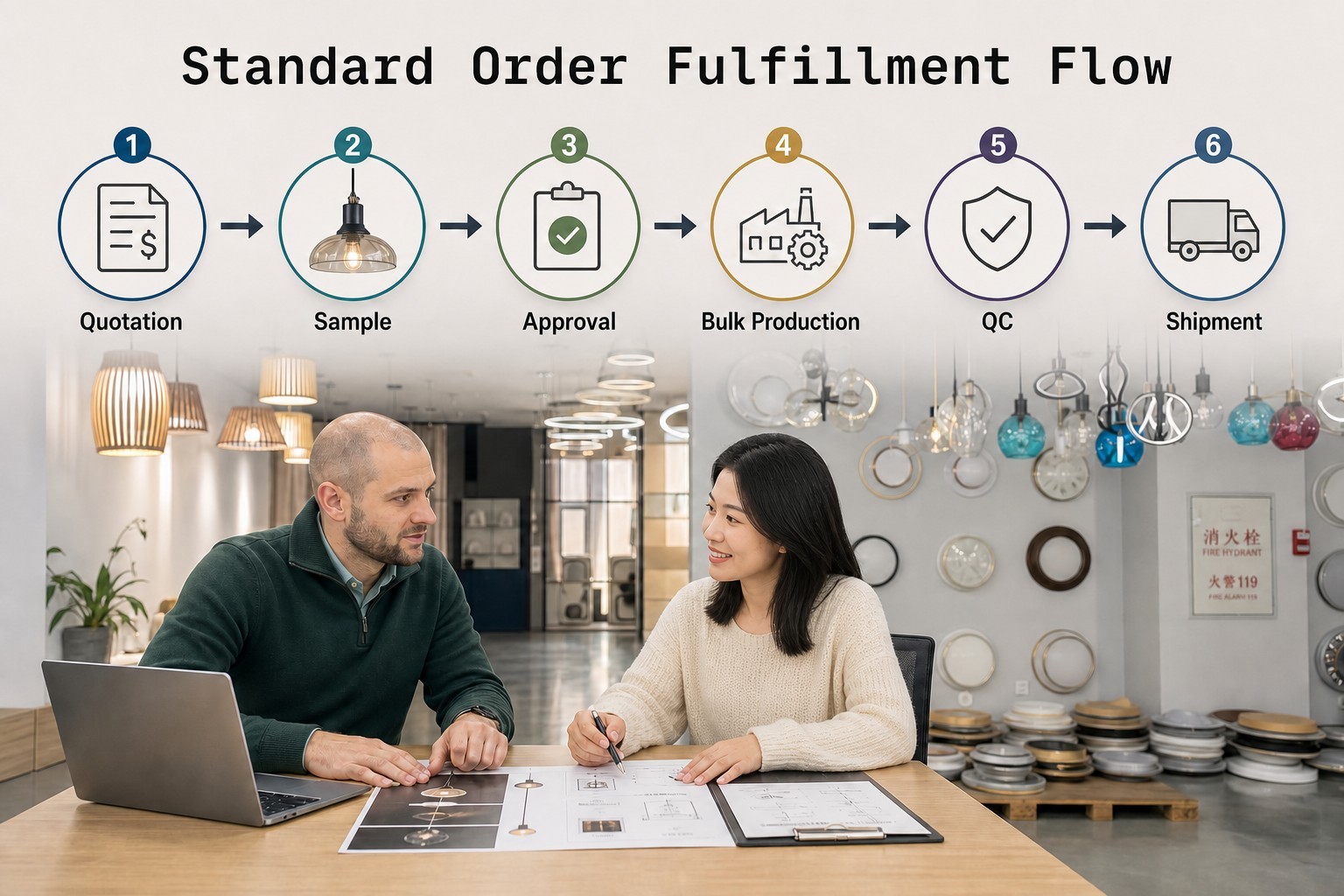
Final Thoughts
The best wholesale lighting supplier is not necessarily the supplier with the lowest price.
Distributors should evaluate the complete sourcing process, including product quality, MOQ, pricing, certifications, OEM/ODM capabilities, quality control, packaging, production lead time, shipping, and after-sales support.
A structured sourcing checklist helps buyers avoid missing important details and makes supplier comparisons more objective.
Before placing a large lighting order, always confirm the specifications, approve samples, clarify commercial terms, calculate the landed cost, and establish quality-control requirements.
A well-defined sourcing process can reduce purchasing risk and create a stronger foundation for long-term cooperation with your lighting supplier.
Learn how minimum order quantities work in our Lighting MOQ Guide.