
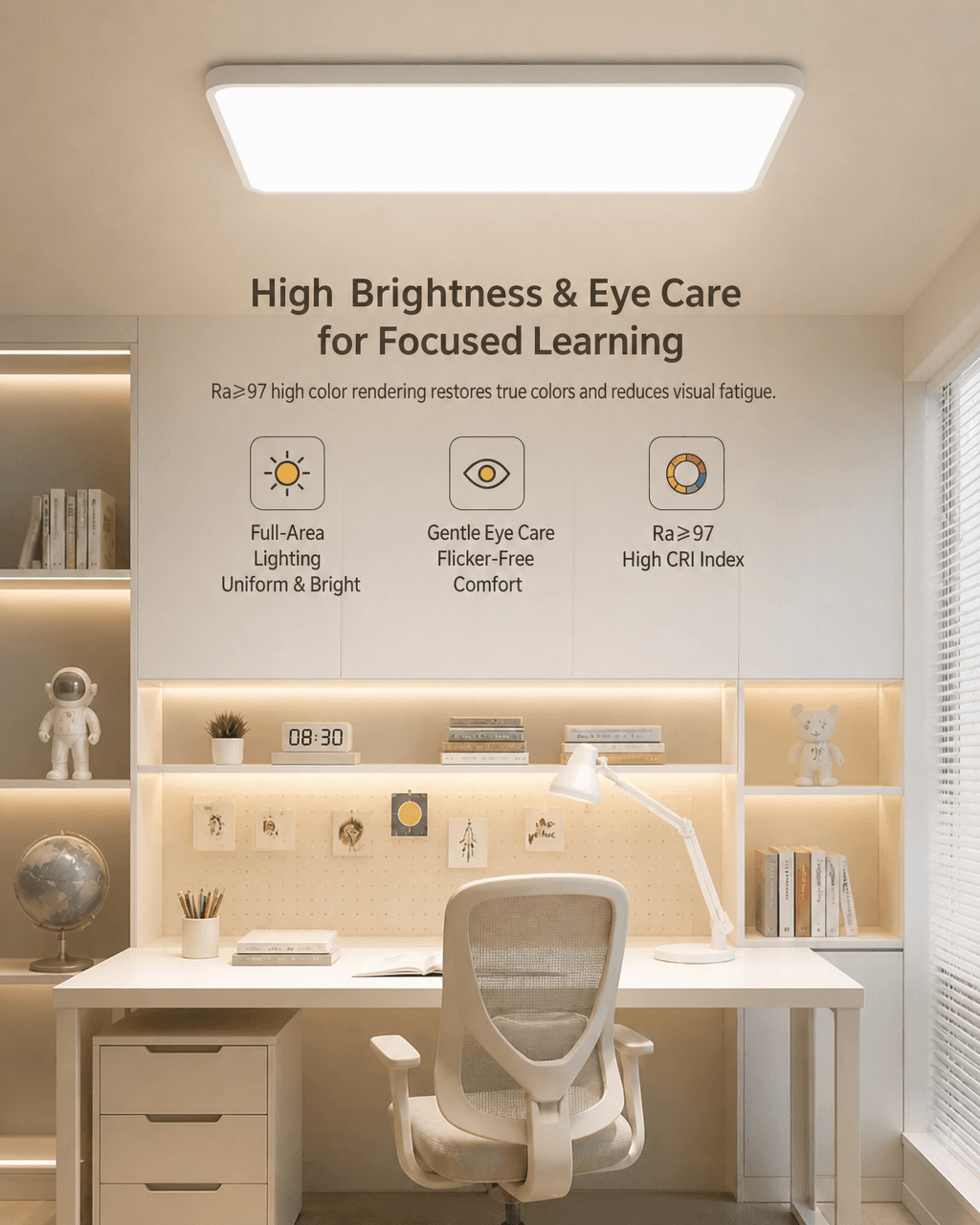
Flicker-Free LED Ceiling Lights: CRI, Uniform Lighting & Eye Comfort
When choosing an LED ceiling light, brightness is only one part of the equation.
A ceiling light can be bright enough to illuminate a room, yet still create an uncomfortable lighting experience because of visible or invisible flicker, poor color rendering, glare, or uneven light distribution.
For bedrooms, studies, dining rooms, apartments, hotels, and other indoor spaces, buyers are increasingly paying attention to three important questions:
Does the LED ceiling light have low or flicker-free operation?
Is the CRI (Ra) above 90?
Does the diffuser provide uniform illumination, or is the center noticeably brighter than the surrounding area?
These factors have a direct impact on perceived lighting quality.
In this guide, we explain the key specifications that lighting buyers, designers, and project purchasers should consider when sourcing LED ceiling lights.
1. Why Lighting Quality Matters Beyond Brightness
Two LED ceiling lights can have the same wattage and similar lumen output but provide very different visual experiences.
One may produce:
Smooth and comfortable illumination
Natural-looking colors
Even light across the diffuser
Controlled glare
Stable light output
Another may produce:
Visible flicker
Harsh glare
Poor color rendering
A bright center with darker edges
Uneven illumination across the room
This is why wattage and lumens alone are not enough to evaluate an LED ceiling light.
For professional lighting selection, it is important to consider the complete optical and electrical system.
2. What Is Flicker in an LED Ceiling Light?
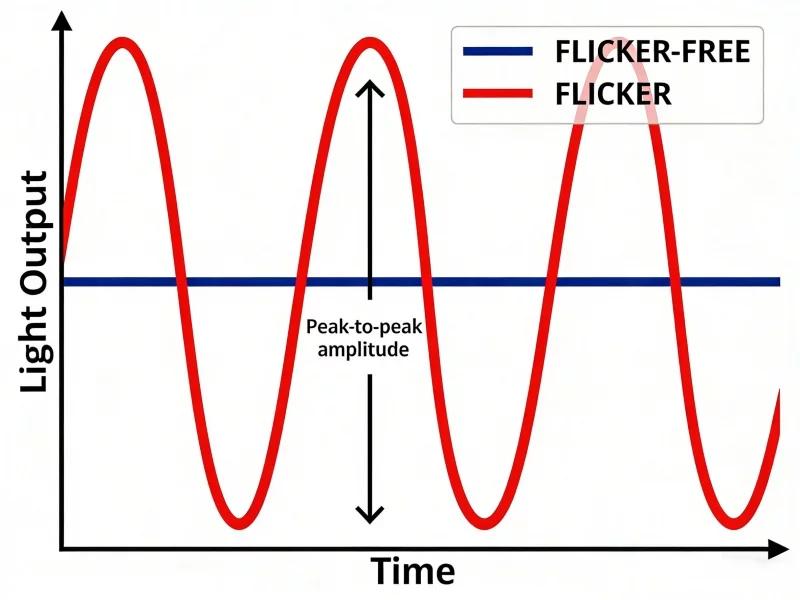
Flicker refers to rapid changes in light output over time.
Although some flicker may not be obvious to the naked eye, certain lighting systems can produce noticeable or less-visible temporal modulation.
The main causes can include:
Driver design
Power supply quality
LED operating conditions
Dimming technology
Electrical compatibility
A well-designed LED ceiling light should use a suitable driver and LED system to provide stable light output.
Is flicker always visible?
No.
Some flicker is obvious, while other forms may be difficult to notice consciously.
This is why simply looking at a lamp and saying:
"I don't see any flicker."
is not a reliable technical evaluation.
For B2B lighting projects, buyers should request appropriate driver specifications and flicker test data where applicable.
3. How Can You Check Whether an LED Ceiling Light Flickers?
There are several levels of evaluation.
Basic visual check
A simple first step is to observe the light directly and through a moving object or moving hand.
However, this is only a basic screening method.
Smartphone camera test
A smartphone camera can sometimes reveal banding or rolling patterns under certain LED lights.
But this method is not a standardized measurement and should not replace professional testing.
Professional measurement
For commercial lighting procurement, manufacturers can provide relevant test data based on applicable measurement methods.
Depending on the product and market, buyers may encounter specifications such as:
Flicker Percentage
Flicker Index
PstLM
SVM
The exact requirements depend on the applicable standards, regulations, and project specifications.
B2B sourcing tip
Instead of asking only:
"Is this light flicker-free?"
ask the manufacturer:
"Can you provide the flicker performance or driver test data for this model?"
This gives buyers a much more objective basis for comparison.
4. What Is CRI or Ra?
CRI stands for Color Rendering Index.
It describes how accurately a light source renders colors compared with a reference illuminant under the relevant measurement framework.
The scale is commonly expressed as Ra.
Generally:
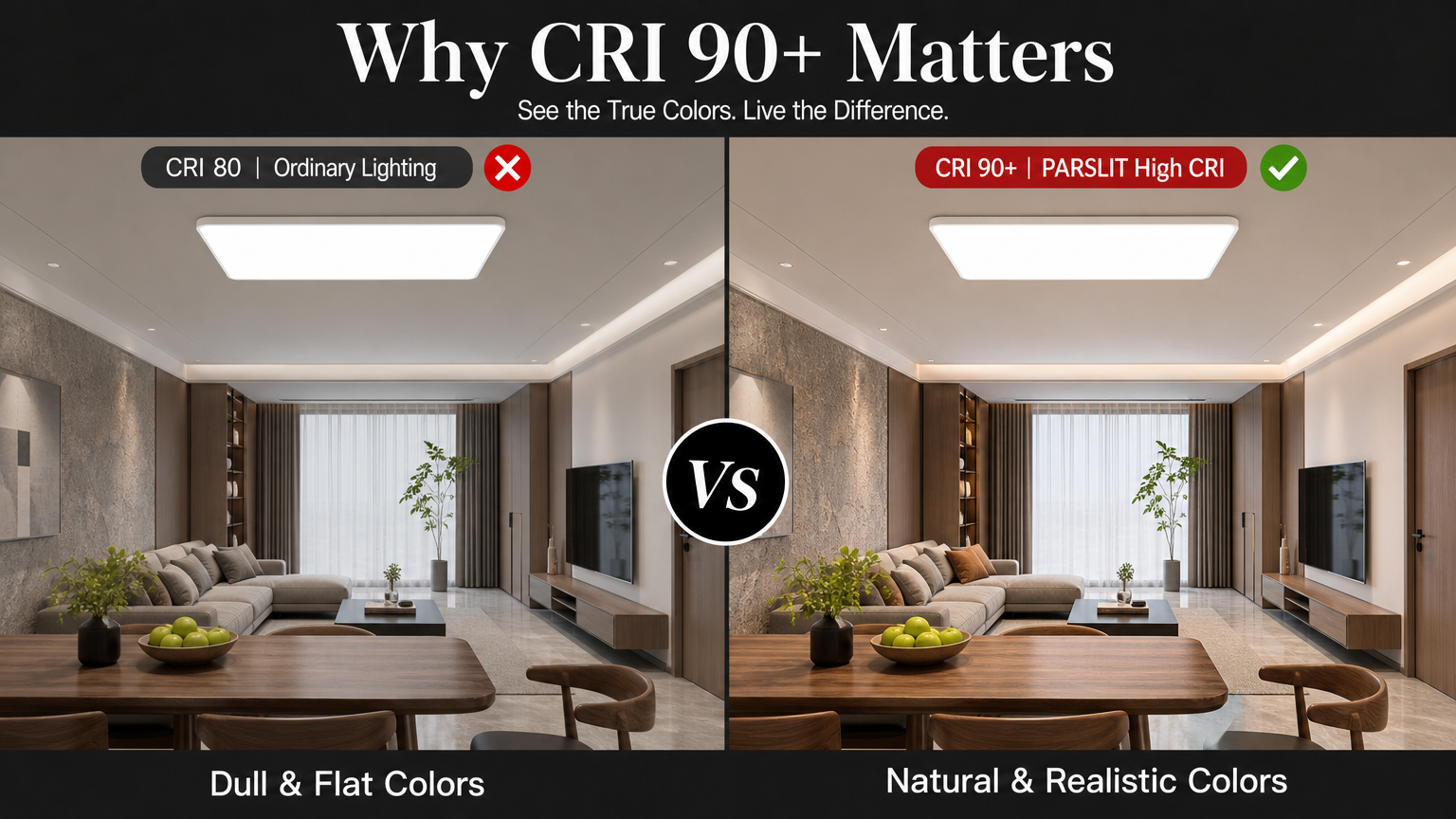
CRI 80: Standard level for many general lighting applications
CRI 90+: High color rendering
CRI 95+: Very high color rendering for applications where color quality is especially important
For residential and hospitality applications where visual comfort and natural-looking colors matter, CRI/Ra ≥90 is often a desirable specification.
5. Why Is CRI 90+ Important?
Imagine a bedroom with neutral-colored furniture, a dining room with natural wood, or a hotel interior with carefully selected fabrics.
Under a low-quality light source, colors may appear:
Dull
Washed out
Slightly distorted
Less natural
With a higher-quality light source, colors can appear more natural and closer to their intended appearance.
This can be particularly important in:
Residential interiors
Hotels
Restaurants
Retail environments
Showrooms
Beauty spaces
Art and display areas
However, CRI should not be treated as the only indicator of color quality.
For professional projects, buyers may also want to consider:
R9
Color temperature
Duv
Color consistency
TM-30 metrics where applicable
6. Is CRI 90 Better Than CRI 80?
For applications where color appearance matters, CRI 90+ generally provides a higher color-rendering level than CRI 80.
But the correct specification depends on the application.
For example:
General utility areas
CRI 80 may be sufficient.
Bedrooms and residential interiors
CRI 90+ can provide a more refined and natural appearance.
Hospitality and retail
CRI 90+ is often preferred when interior materials and product colors need to look natural.
High-end display environments
Additional color-quality metrics may be required beyond basic CRI.
Therefore, the right question is not simply:
"What is the highest CRI?"
but:
"What color quality does this application actually require?"
7. Why Does a Ceiling Light Sometimes Look "Bright in the Middle and Dark Around the Edges"?
This is one of the most common problems with poorly designed ceiling lights.
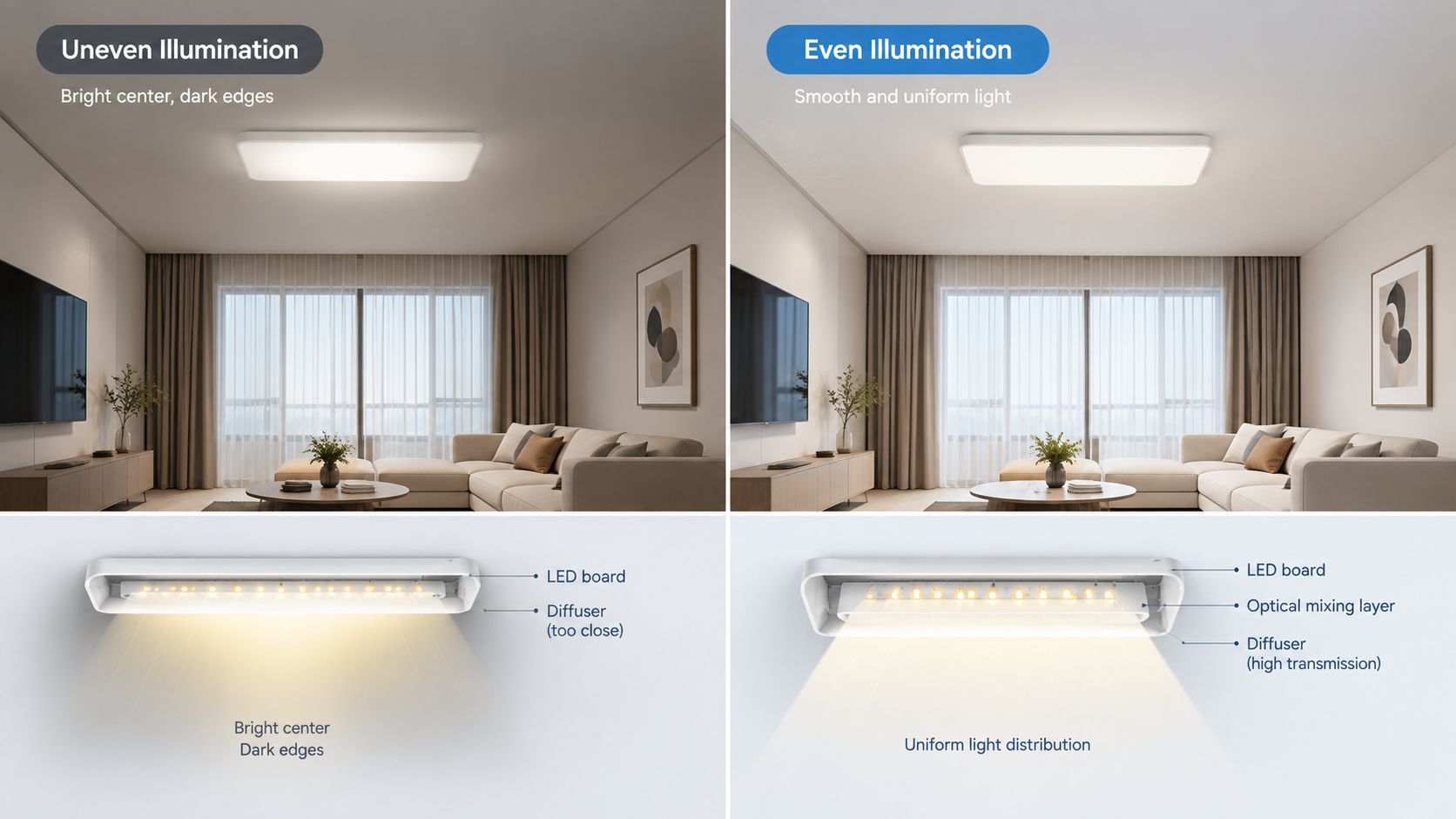
You may see a fixture that appears extremely bright at the center while the outer diffuser looks noticeably darker.
This can happen because the LED light source and optical structure are not distributing light evenly across the diffuser.
A typical structure might look like:
LED → Diffuser
If the LED spacing, LED-to-diffuser distance, optical design, or diffuser characteristics are not properly matched, bright spots or dark zones can become visible.
The result can be a "hot spot" in the center.
8. What Causes Uneven Illumination?
Several factors can contribute.
LED Spacing
If LEDs are positioned too far apart, the diffuser may not receive uniform illumination.
LED-to-Diffuser Distance
The distance between the LED source and diffuser affects how much the individual light points blend together.
Diffuser Material
A diffuser with poor optical performance may not distribute light effectively.
Light Guide or Optical Structure
Depending on the product design, optical films, light guides, reflectors, or internal structures may be used to improve uniformity.
Housing Depth
The overall fixture thickness can influence the available optical mixing distance.
This is particularly important for ultra-slim LED ceiling lights.
Making the fixture thinner is not simply a matter of reducing the housing depth.
The LED, diffuser, driver, thermal management, and optical structure still need to work together.
9. How Does a Good Diffuser Improve Lighting Quality?
A well-designed diffuser has several important functions.
1. Reduce Visible LED Hot Spots
The diffuser helps blend individual LED points into a more continuous luminous surface.
2. Improve Visual Uniformity
The light-emitting surface can appear more consistent from the center to the edges.
3. Reduce Direct Glare
The diffuser can help soften the apparent brightness of the LED source.
4. Create a Cleaner Appearance
A uniformly illuminated diffuser gives the ceiling light a more premium appearance.
This is especially important for modern flat-panel and slim ceiling light designs.
10. Why Does a Thinner Ceiling Light Make Uniform Lighting More Difficult?
This is an important consideration when sourcing ultra-slim LED ceiling lights.
A deeper fixture provides more internal space for optical mixing.
When the fixture becomes thinner, the distance between:
LED → Optical Structure → Diffuser
becomes more limited.
If the design is not optimized, this can lead to:
Visible LED dots
Bright center
Dark edges
Uneven diffuser brightness
Glare
Therefore:
Slimmer does not automatically mean better.
A good ultra-slim ceiling light must balance low profile, optical uniformity, thermal performance, and electrical reliability.
11. Flicker, CRI and Uniformity Should Be Considered Together
These three factors solve different problems.
Lighting Quality | Main Concern | What to Check |
|---|---|---|
Flicker | Light output stability | Driver & flicker data |
CRI | Color appearance | Ra / CRI ≥90 where required |
Uniformity | Even appearance | Diffuser & optical design |
Glare | Visual comfort | Diffuser, optics, brightness |
Color consistency | Product consistency | SDCM / color binning |
A ceiling light with high CRI but poor flicker performance is not automatically a high-quality product.
Likewise, a flicker-controlled product with excellent uniformity may still have insufficient color rendering for a high-end project.
The best result comes from treating these characteristics as a complete lighting system.
12. What Should B2B Buyers Ask the Manufacturer?
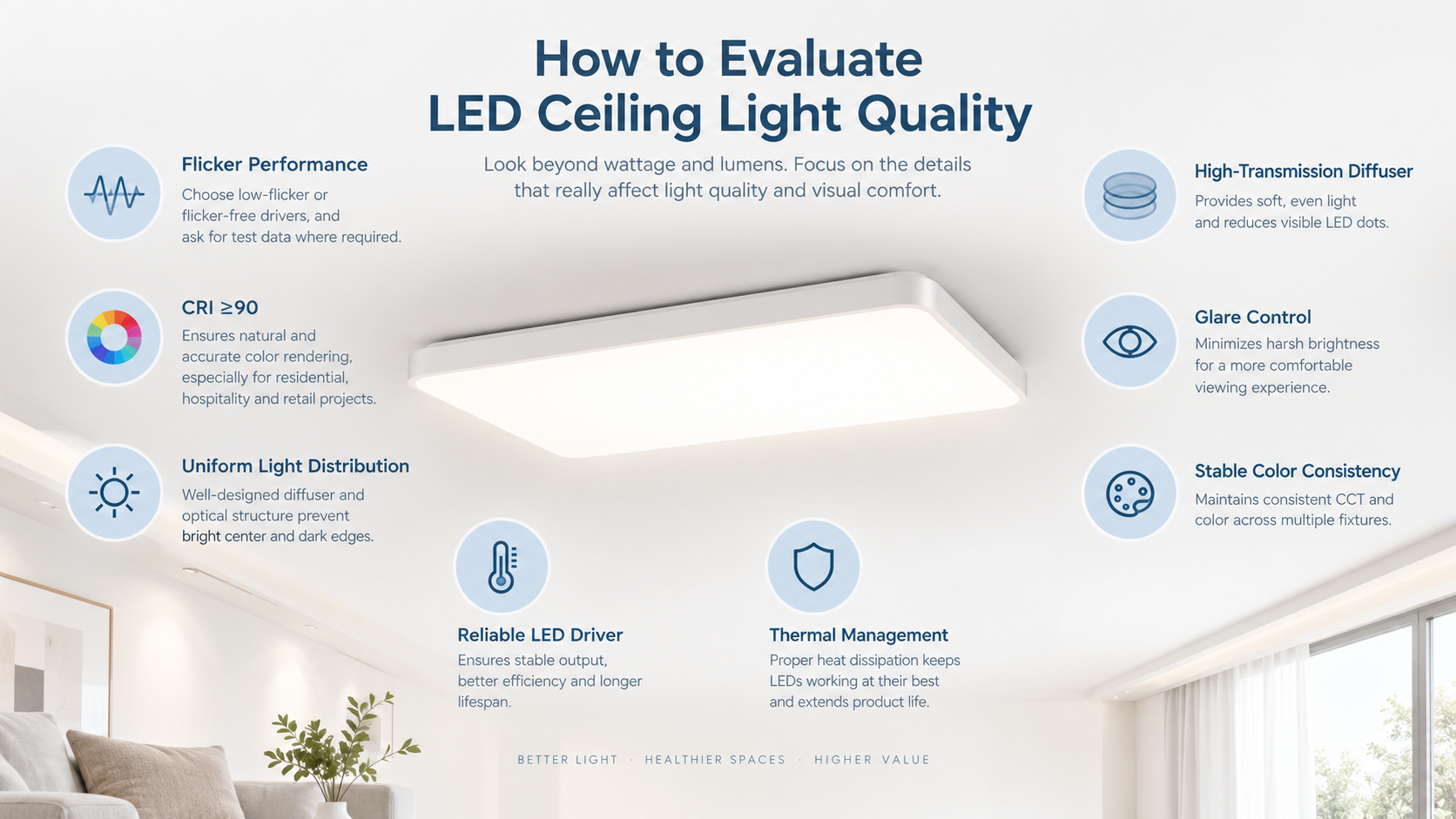
When sourcing LED ceiling lights, consider asking the supplier for the following information:
Electrical
Input voltage
Wattage
Driver specifications
Power factor
Surge protection
Dimming compatibility
Flicker performance
Light Quality
Lumens
CRI / Ra
R9 where relevant
CCT
Beam angle
Color consistency
Lumen maintenance
Optical Design
Diffuser material
LED arrangement
Optical structure
Light distribution
Uniformity performance
Glare characteristics
Product Construction
Fixture thickness
Housing material
Heat dissipation
LED module
Driver location
Installation structure
This information makes it easier to compare different suppliers objectively.
13. What Is a Good Specification for a Residential LED Ceiling Light?
There is no single specification that is perfect for every application.
However, for many modern residential projects, a reasonable starting specification might include:
CRI: ≥90
Color Temperature: 3000K–4000K depending on the room and design
Flicker: Low-flicker or flicker-controlled driver, with test data available where required
Diffuser: High-transmission, well-diffusing material
Light Distribution: Broad and uniform
Glare: Controlled for comfortable viewing
Fixture Profile: Slim flush mount design where ceiling height is limited
The final specification should always be adjusted according to the project, local requirements, and applicable standards.
14. How to Choose a High-Quality LED Ceiling Light
When comparing two products, don't focus only on price and wattage.
Use this checklist:
✓ Check Flicker Performance
Ask for driver information and relevant test data.
✓ Check CRI
For applications where color quality matters, consider CRI/Ra ≥90.
✓ Look at the Entire Diffuser
The diffuser should appear reasonably uniform rather than having an obvious bright center and dark perimeter.
✓ Check Glare
A brighter light is not necessarily a more comfortable light.
✓ Check Color Consistency
For multiple fixtures in the same project, consistent color appearance is important.
✓ Check Thermal Design
LED performance and lifetime depend on appropriate thermal management.
✓ Check Driver Quality
The driver is a critical part of the overall LED system.
15. A Simple Comparison: Two Ceiling Lights
Imagine two 24W LED ceiling lights.
Product A
24W
2400 lm
CRI 80
Basic driver
Visible central hot spot
Uneven diffuser
Product B
24W
2200–2400 lm
CRI 90+
Better-controlled driver
More uniform diffuser
Better glare control
Even though their wattage and lumen output are similar, Product B may provide a noticeably better visual experience.
This illustrates an important principle:
Lighting quality cannot be judged by wattage and lumens alone.
Final Takeaway
A high-quality LED ceiling light is about much more than brightness.
For modern residential and commercial projects, buyers should look beyond wattage and lumens and evaluate the complete lighting system.
Three key areas deserve particular attention:
1. Flicker performance
A suitable driver can help provide more stable light output.
2. Color rendering
For applications where color quality matters, CRI/Ra ≥90 is often a desirable target.
3. Light uniformity
A well-designed diffuser and optical structure can help prevent a noticeable bright center and dark edges.
For B2B lighting procurement, the best approach is to request actual specifications and test data, rather than relying only on marketing terms such as "eye-caring," "flicker-free," or "high CRI."
A well-engineered LED ceiling light should combine stable electrical performance, high-quality color rendering, controlled glare, and uniform illumination—while maintaining the slim and clean appearance required by modern interiors.