
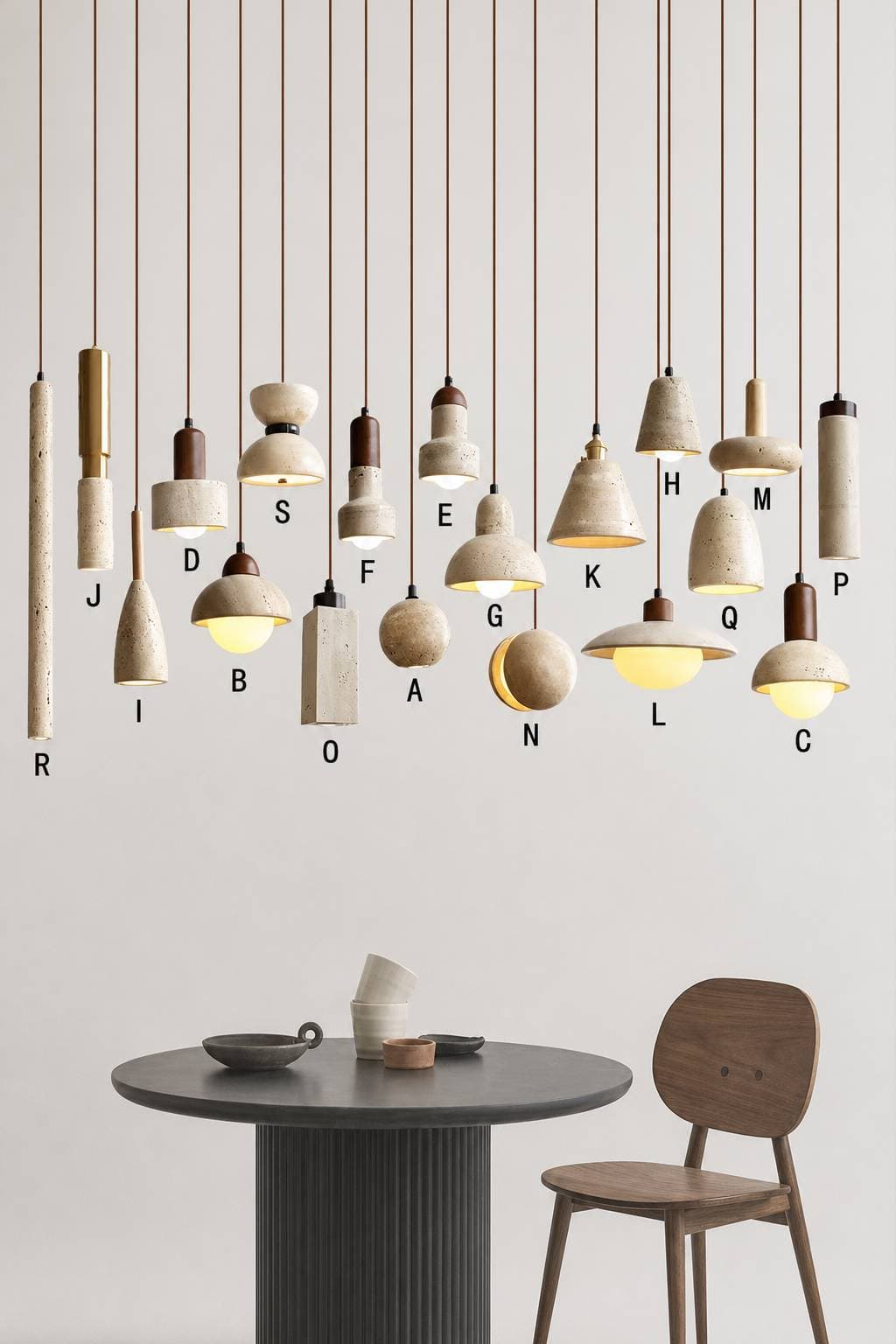
Travertine-Look Pendant Lights: Materials, Designs and Wholesale Buying Guide
Travertine-look pendant lights combine textured surfaces, warm earthy colors, and sculptural shapes for residential and commercial interiors. For lighting distributors, retailers, interior designers, and project buyers, the key is to understand the difference between natural travertine and travertine-look materials, compare pendant designs, and check the technical specifications before placing a bulk order.
Cement pendants with a travertine-inspired finish offer another option for buyers who want a porous stone-like appearance. They can be developed in different shapes, colors, and lighting configurations, making them suitable for coordinated lighting collections and OEM/ODM projects.
This guide explains how to evaluate travertine-look pendant lights, choose suitable designs, and source products for wholesale and commercial applications.
Quick Answer: What Are Travertine-Look Pendant Lights?
Travertine-look pendant lights are hanging light fixtures designed with colors and surface textures inspired by travertine, a natural limestone. Depending on the product, the shade may be made from natural stone, cement, resin composites, or other materials with a similar appearance.
The term “travertine-look” describes the visual finish, not necessarily the material itself. Buyers should check the manufacturer's material specification rather than assuming that a product advertised as a travertine pendant is made from natural stone.
For wholesale buyers, the main factors to compare are material, dimensions, light source, color temperature, suspension hardware, finish consistency, packaging, and customization options.
1. Why Are Travertine-Look Pendant Lights Used in Interior Projects?
Travertine-inspired lighting fits interiors that use natural colors, tactile surfaces, and simple geometric forms. Unlike a highly polished decorative fixture, a porous or matte finish adds visual texture without requiring a complicated shape.
Warm and neutral color options
Yellow, beige, cream, and sand-colored finishes work with wood furniture, neutral walls, textured plaster, and natural fabrics. Black versions offer a stronger contrast for contemporary restaurants, bars, and modern residential interiors.
For lighting brands and distributors, offering more than one color can help build a collection that serves different interior styles without changing the overall product concept.
Distinctive shapes for different spaces
The surface finish is only one part of a pendant's design. The shape also determines how the product fits into an interior.
Common options include:
Dome pendants for counters and dining areas
Cylindrical pendants for bedside lighting and repeated installations
Sphere-shaped pendants for compact decorative lighting
Hourglass designs for sculptural ceiling arrangements
Disc-shaped pendants for broad, low-profile silhouettes
Conical pendants for directional downward lighting
A coordinated range with several shapes can give retailers and project buyers more flexibility than a single pendant design.
Decorative and functional roles
A pendant may serve as a visual feature, provide localized illumination, or contribute to a layered lighting scheme. These functions depend on the light source, output, shade opening, installation height, and surrounding lighting.
A textured cement shade does not automatically guarantee soft or glare-free light. Buyers should review the actual light distribution and, when necessary, request illuminated product photos or lighting test data.
2. Natural Travertine vs. Travertine-Look Cement: What Is the Difference?
This distinction is especially important for importers, distributors, and private-label brands. Similar-looking products may use different materials and production methods, which can affect weight, appearance, handling, and product positioning.
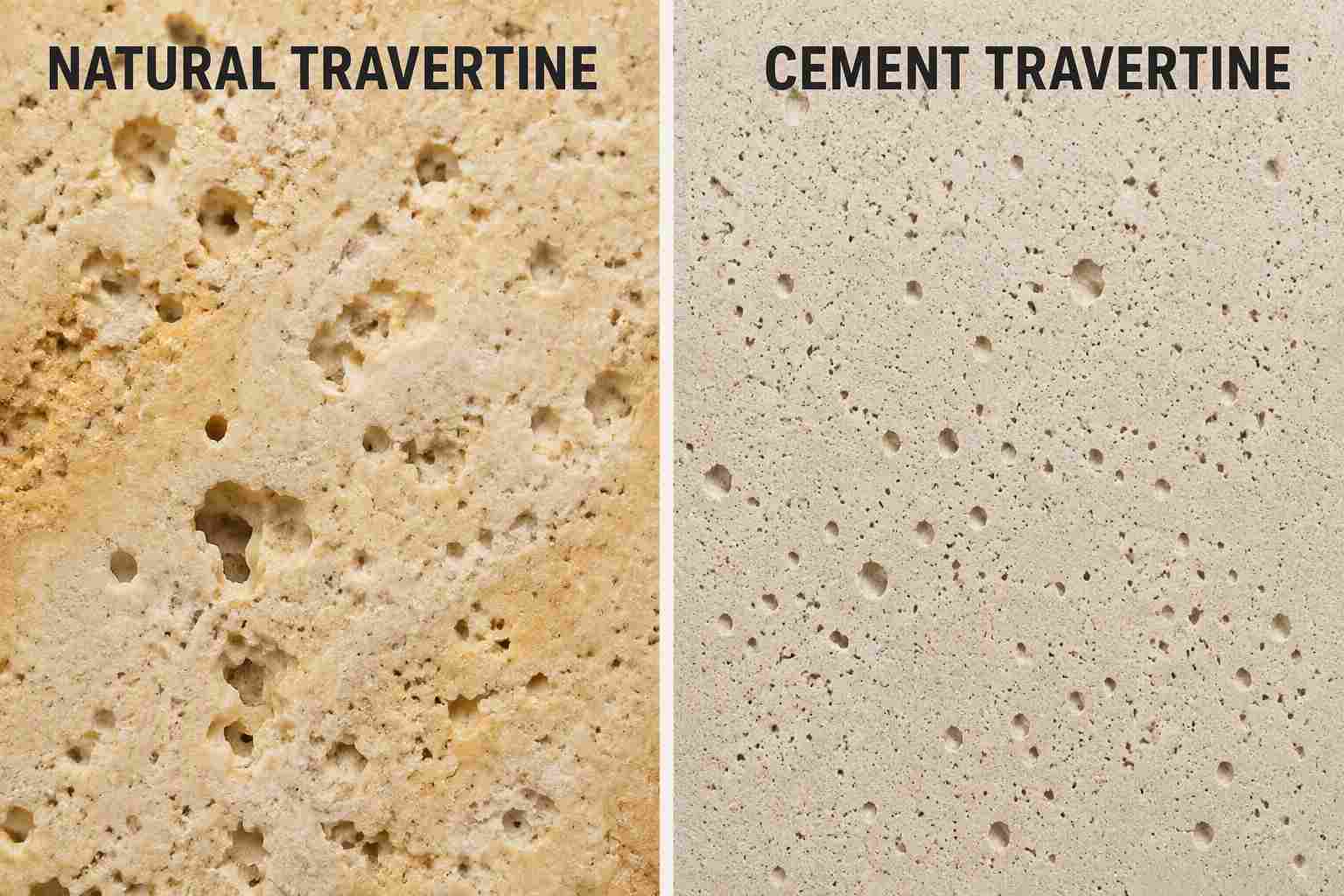
Comparison | Natural Travertine | Travertine-Look Cement |
|---|---|---|
Main material | Natural stone | Cement with a textured finish |
Surface appearance | Natural pores and mineral variation | Manufactured texture designed to resemble stone |
Pattern consistency | Natural variations between pieces | Can be developed toward a more consistent appearance |
Design flexibility | Depends on stone selection and processing | Shapes and surface finishes can be specified during product development |
Material description | Can be marketed as natural travertine when verified | Should be marketed as travertine-look cement |
Buyer checks | Stone origin, weight, finish, mounting requirements | Cement composition, finish consistency, weight, mounting requirements |
Neither material is automatically the better choice for every project. The right option depends on the intended appearance, product specifications, project budget, and customer expectations.
Why accurate material descriptions matter
A product made from cement should not be described as natural travertine, volcanic stone, or solid stone unless those claims are verified.
For example, “yellow travertine-look cement pendant light” clearly communicates both the appearance and the actual shade material. This wording is useful for product catalogs, B2B quotations, and online listings because it reduces the risk of misunderstandings between suppliers and buyers.
When evaluating a supplier, ask for a material specification and a close-up image of the actual finish. Product titles and lifestyle photos alone are not sufficient to confirm the material.
3. Which Travertine-Look Pendant Shape Should You Choose?
Different pendant shapes serve different design purposes. The following comparison can help distributors and project buyers build a product range around several applications.
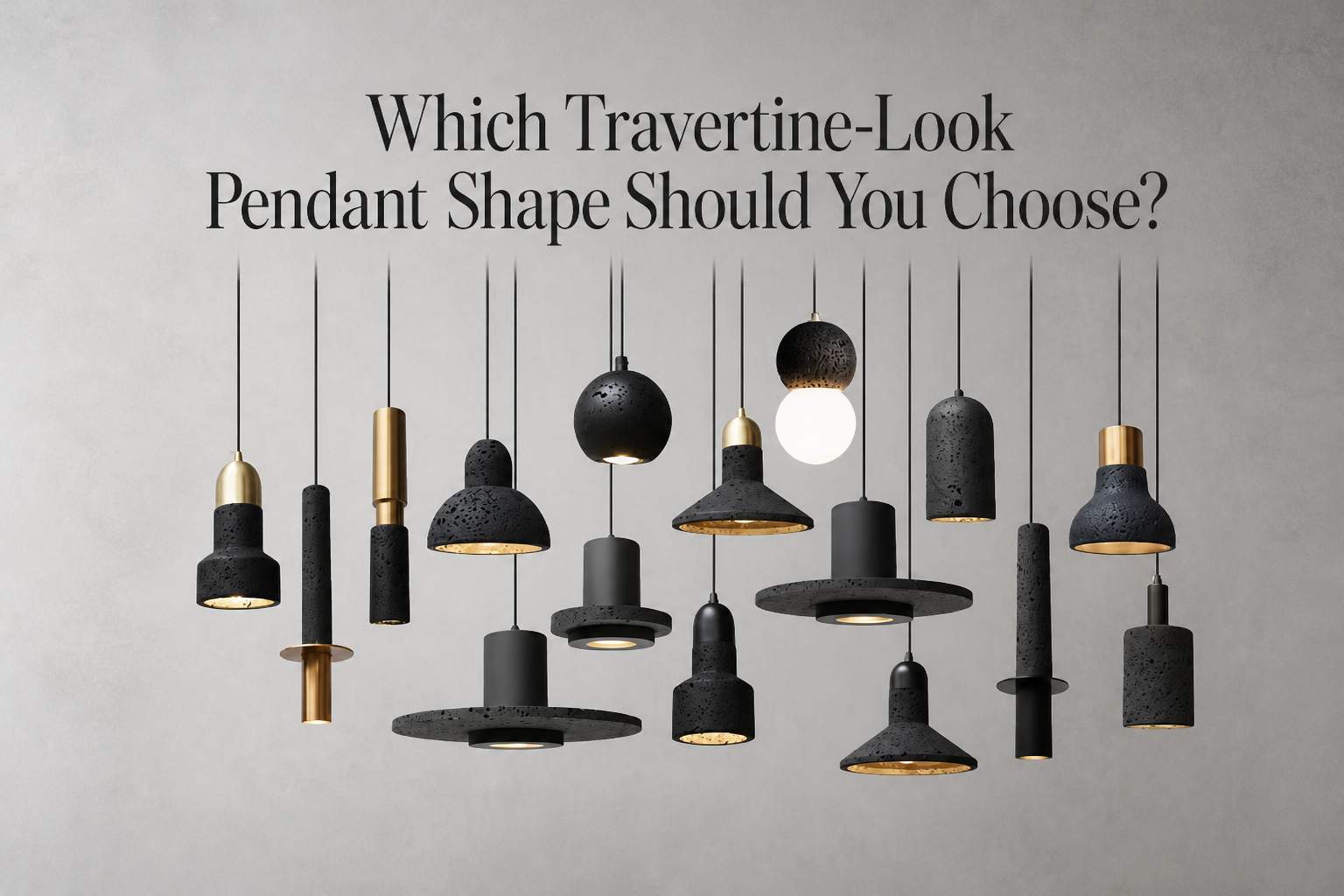
Pendant Shape | Main Design Character | Potential Applications | What Buyers Should Check |
|---|---|---|---|
Dome | Rounded shade with a defined lower opening | Kitchen islands, dining counters | Shade diameter and light direction |
Cylinder | Slim vertical profile | Bedside areas, bars, repeated installations | Body height and beam distribution |
Sphere | Rounded, compact silhouette | Bedrooms, corridors, decorative groupings | Opening design and bulb access |
Hourglass | Two opposing rounded sections | Contemporary interiors, feature lighting | Upward and downward light output |
Disc | Wide, relatively shallow profile | Dining areas, reception spaces | Overall diameter and mounting clearance |
Cone | Tapered form with a directional appearance | Counters, bedside tables, hospitality interiors | Beam direction and bulb compatibility |
The table describes general design applications rather than guaranteed lighting performance. Final suitability should be confirmed against each model's actual dimensions and photometric data.
Dome and conical pendants
These shapes are practical starting points for buyers who need a recognizable pendant design. Their downward-facing form can work well above smaller surfaces, although the actual light distribution depends on the opening, bulb, and internal structure.
Cylindrical pendants
Slim cylinders are useful where the designer wants a strong vertical line rather than a broad shade. They can be installed individually or in groups, with suspension heights adjusted to suit the layout.
For commercial projects, buyers should confirm the spacing and lighting requirements before specifying multiple units.
Sphere and hourglass pendants
Rounded designs place more emphasis on the shape of the fixture itself. A split-sphere design uses an opening as part of its visual identity, while an hourglass design combines two opposing rounded sections.
These styles can help a lighting brand develop a recognizable decorative range. However, buyers should verify whether the product uses a replaceable bulb or an integrated LED module, as this affects maintenance and replacement planning.
4. How Should Buyers Select the Right Light Source?
The shade material and exterior design do not tell the whole story. Light-source configuration affects brightness, maintenance, dimming options, and the suitability of a pendant for different projects.
Replaceable bulbs
Common bulb-base configurations include E27, G9, and GU10, depending on the design.
E27: A screw-base option commonly used in decorative lighting.
G9: A compact bulb base used in smaller fixtures.
GU10: A spotlight-style base that can be suitable for directional lighting.
These bases are not interchangeable. Buyers must check the exact holder, compatible bulb dimensions, wattage limits, voltage, and whether the bulb is included.
Integrated LED modules
Some decorative pendants use built-in LED modules instead of replaceable bulbs. This can support a specific lighting arrangement, such as upward and downward illumination, but it also makes it important to clarify maintenance and replacement arrangements.
For integrated LED models, request the following information:
Total power consumption in watts
Color temperature
Lumen output, if available
Dimming capability and compatible controls
Driver specifications, where applicable
Expected maintenance or replacement procedure
Do not assume that a product is dimmable or flicker-free unless the supplier confirms it with appropriate specifications or test data.
Choosing a color temperature
Warm white light, often around 2700K–3000K, is commonly considered for restaurants, bedrooms, and hospitality settings where a warm atmosphere is desired. Other color temperatures may be more appropriate for projects with different functional or visual requirements.
The best choice depends on the project's lighting design, surface colors, and intended use. Buyers should confirm the available color temperature for each model instead of assuming that the entire product range uses the same configuration.
5. Where Can Travertine-Look Pendant Lights Be Used?
Travertine-look cement pendants can be considered for a range of interior settings, provided their dimensions, light output, and installation requirements are suitable.
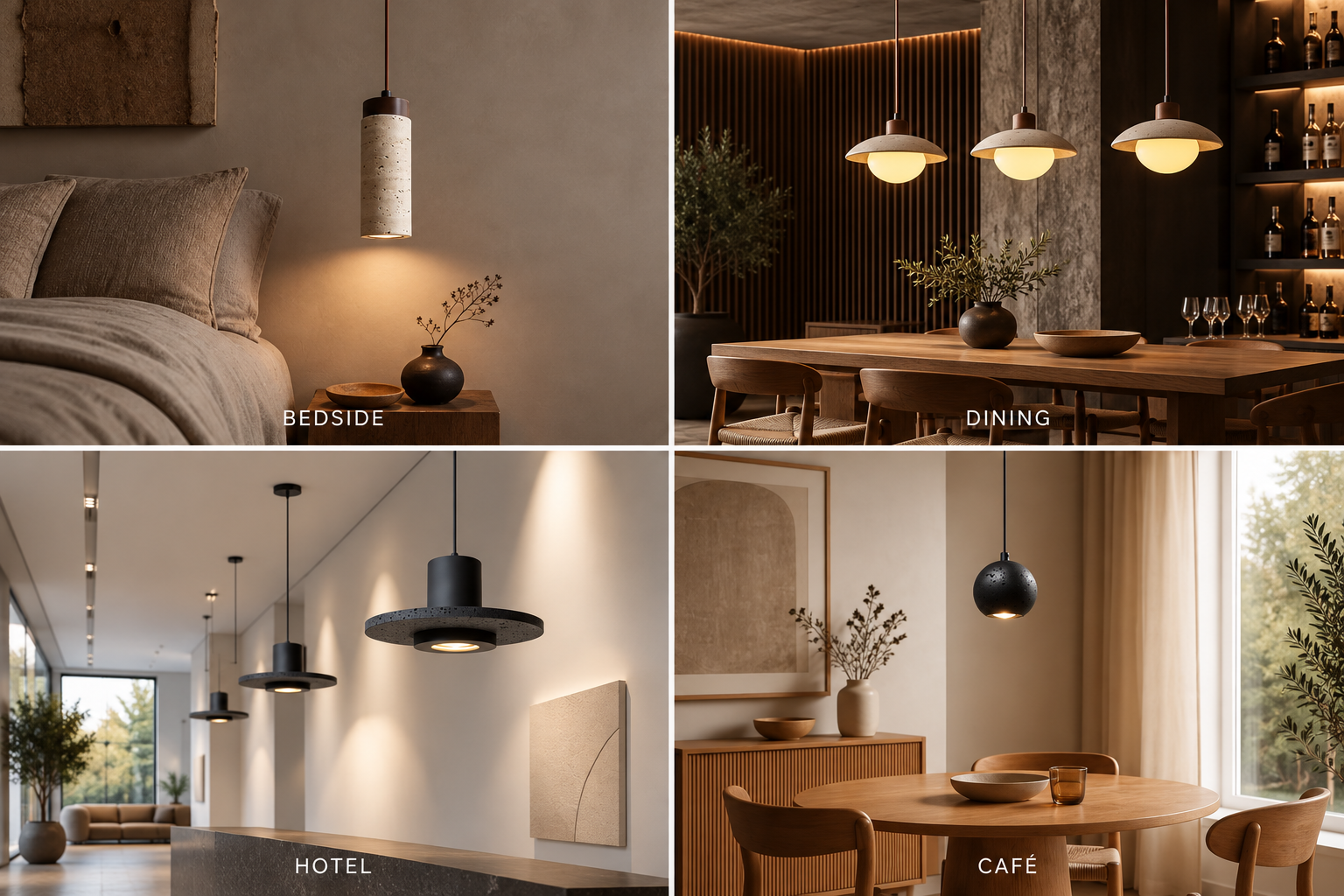
Hotels and hospitality interiors
Compact sphere, cylinder, and dome designs can be considered for bedside areas, reception spaces, and selected decorative zones. For hotel projects, buyers should confirm electrical requirements, maintenance access, and the consistency of finish across the required quantity.
Restaurants and cafés
Pendant lights can help define dining tables, counters, and bar areas. A group of smaller pendants may suit a long counter, while a larger design may be used as a more prominent decorative element.
Before specifying a model, check the light output and installation height to ensure that the fixture serves the intended purpose rather than functioning only as decoration.
Residential projects
Yellow and beige stone-look finishes can complement warm wood, neutral palettes, and textured walls. Black finishes can work with darker furniture, metal details, and more contrasting interior schemes.
Potential applications include kitchen islands, bedside areas, dining corners, and entryways. Damp or outdoor use should not be assumed unless the product has the required protection rating.
Retail and commercial fit-outs
For retail displays and commercial interiors, repeated pendant designs can help maintain a consistent visual theme. Distributors and contractors should verify dimensions, mounting details, lead times, and spare-part availability before confirming a project specification.
6. What Should Wholesale Buyers Check Before Placing an Order?
For B2B purchasing, a product image is only the beginning. A clear specification helps reduce confusion during quotation, sampling, production, and delivery.
Wholesale purchasing checklist
Use this checklist when evaluating a travertine-look pendant supplier.
Material: Confirm whether the shade is natural stone, cement, resin, or another material.
Finish: Request close-up photos and confirm the acceptable range of color and texture variation.
Dimensions: Check shade size, overall height, canopy diameter, and suspension length.
Light source: Confirm the bulb base or LED module, wattage, color temperature, and whether the source is included.
Electrical specifications: Verify voltage, driver details where applicable, and the requirements of the destination market.
Dimming: Confirm compatibility if the project requires dimming.
Installation: Check mounting hardware, cable adjustment, weight, and installation instructions.
Certifications: Request documentation applicable to the exact model and target market. Do not assume every model has the same approvals.
Packaging: Ask how the shade and hardware are protected during export transportation.
Order terms: Confirm MOQ, sample availability, production lead time, spare parts, and shipping terms.
Customization: Clarify which colors, finishes, materials, labels, and packaging options are available for the requested quantity.
Why samples and approved specifications matter
A sample allows the buyer to assess the actual texture, finish, proportions, and light effect before committing to a larger order. For repeat purchases, retain an approved sample or a documented specification as a reference for future batches.
If a project depends on consistent appearance, agree on how color and texture variations will be evaluated. If a project depends on lighting performance, request the relevant electrical and photometric information rather than relying on appearance alone.
7. Can Travertine-Look Cement Pendant Lights Be Customized?
Customization can help lighting brands and distributors develop a range that fits their own market. Available options depend on the product structure, supplier capability, order quantity, and technical requirements.
Common OEM/ODM discussion points include:
Color and finish: Adjusting the shade color or surface appearance to fit a product collection.
Hardware finish: Coordinating metal components and ceiling canopies with the shade.
Dimensions and proportions: Reviewing whether a product can be adapted to project requirements.
Light-source configuration: Confirming whether a different bulb base, LED module, color temperature, or control arrangement is technically feasible.
Branding and packaging: Discussing logo application, product labels, cartons, and packaging design.
Documentation: Preparing accurate product specifications and relevant model-specific compliance documents for the intended market.
Not every change is possible on every model. Buyers should ask for a feasibility review, sample approval, and written confirmation of specifications before mass production.
8. PARSLIT Travertine-Look Cement Pendant Collection
PARSLIT offers cement pendant designs with travertine-inspired textures in different shapes and configurations. The range can be explored by shape, color, and lighting arrangement to support retail collections and interior projects.
Examples include:
PDL-10Q: Elongated Dome Pendant
A compact dome-shaped design with a yellow travertine-look cement finish. Its rounded profile is an option for buyers looking for a more traditional pendant silhouette with a textured surface.
Product page: https://parslit.com/products/elongated-dome-travertine-look-cement-pendant-pdl-10q
PDL-11R: Slender Column Pendant
A narrow, vertical design that offers a different visual profile from a dome or sphere. It can be considered for bedside areas and repeated pendant arrangements, subject to the project's lighting requirements.
Product page: https://parslit.com/products/slender-yellow-cement-column-pendant-light-pdl-11r
PDL-12S: Dual-Glow Hourglass Pendant
This model combines two opposing rounded sections in an hourglass-like shape. The listed configuration uses integrated dual COB LEDs with warm white 3000K light and is designed to emit light upward and downward.
Product page: https://parslit.com/products/dual-glow-hourglass-travertine-look-cement-pendant-pdl-12s
PDL-12N: Split-Sphere Pendant
A compact spherical design with a vertical opening. The listed configuration uses a G9 LED light source with warm white 3000K light, offering a different shape and lighting arrangement from the PDL-12S.
Product page: https://parslit.com/products/split-sphere-travertine-look-cement-pendant-pdl-12n
These models use travertine-look cement, not verified natural travertine. Buyers should review each product page and confirm the latest specifications, included light source, available finishes, and order requirements before purchasing.
9. Why Work with PARSLIT for Wholesale Lighting?
PARSLIT serves lighting wholesalers, distributors, interior designers, and project buyers seeking decorative lighting products for different markets.
For travertine-look cement pendants, the buying process can include model selection, specification review, sample evaluation, and discussion of customization requirements.
PARSLIT lists OEM/ODM options such as color customization, material-finish adjustments, logo application, packaging design, and specification modification. The feasibility of each option should be confirmed for the selected model and order quantity.
Before requesting a quotation, prepare the following information:
Model numbers and required quantities
Target market and destination country
Preferred color and finish
Required bulb or LED configuration
Voltage and certification requirements
Packaging and branding needs
Target delivery date
Providing these details helps suppliers assess the request more accurately and identify the information needed for a quotation.
Looking for travertine-look cement pendant lights for your next collection or project? Explore the PARSLIT pendant range and contact the team to discuss wholesale pricing, samples, and OEM/ODM requirements.
Conclusion
Travertine-look pendant lights give lighting brands and project buyers a way to combine textured surfaces with a range of contemporary shapes. However, choosing the right product requires more than comparing photos.
Confirm the actual shade material, evaluate the light source and dimensions, check finish consistency, and agree on technical requirements before placing a bulk order. For distributors and project buyers, clear specifications and sample approval are essential steps toward a more predictable sourcing process.
Explore the PARSLIT cement pendant collection or contact the team to discuss wholesale, project, and OEM/ODM requirements.