
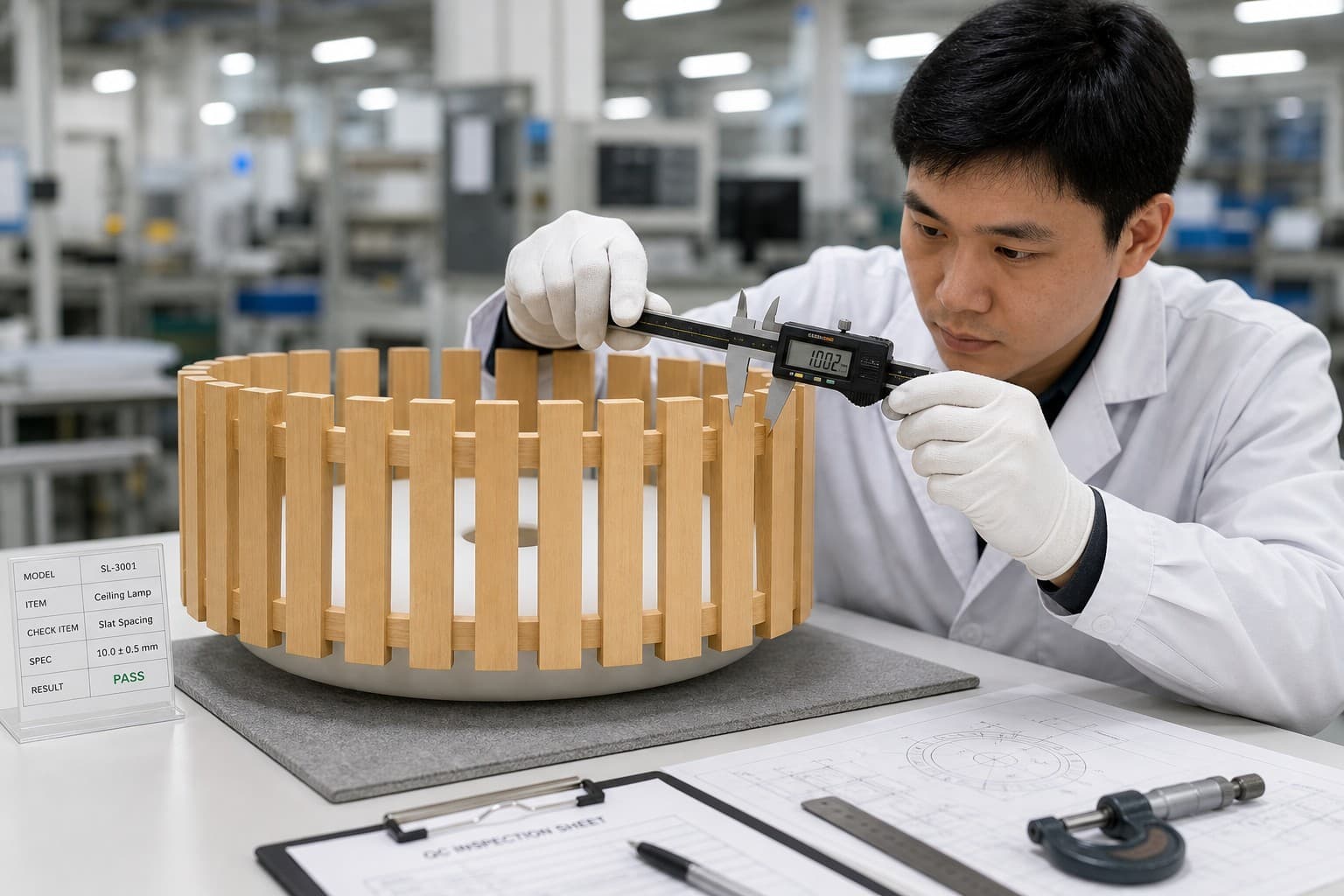
Why Lighting Quality Control Matters Before Bulk Production
Quality control before bulk production helps buyers identify product problems before they affect a large order. A lighting sample may look good individually, but small issues with materials, dimensions, electrical components, finishes, or assembly can become costly when multiplied across hundreds or thousands of units.
For wholesale lighting buyers, distributors, retailers, and project suppliers, quality should therefore be checked at several stages:
Before sample approval
During product development
Before bulk production
During production
Before shipment
The most important point is to establish clear quality requirements before mass production begins.
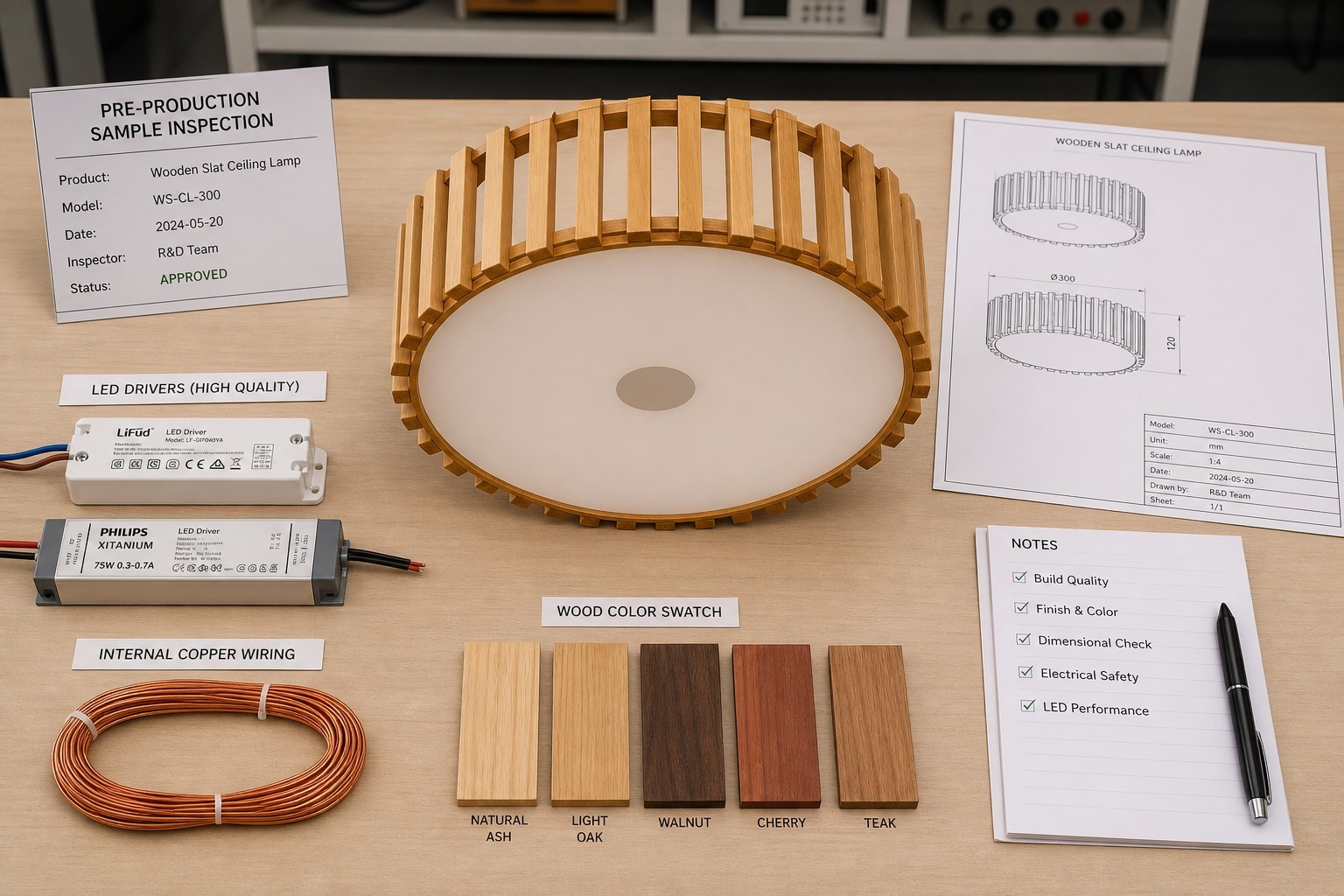
What Should Buyers Check Before Bulk Lighting Production?
Before approving a lighting product for bulk production, buyers should review the following key areas.
1. Product Dimensions and Specifications
Confirm that the sample matches the approved product specifications.
Check:
Overall dimensions
Product weight
Lampshade dimensions
Mounting dimensions
Cable length
Ceiling canopy size
Screw and mounting-hole positions
Product structure
Adjustable angles or moving parts
For projects or retail products, even small dimensional differences can cause installation or packaging problems.
It is useful to create an approved specification sheet containing the exact measurements that the manufacturer must follow during production.
2. Materials and Components
The materials used in bulk production should match the approved sample and specifications.
Depending on the lighting product, buyers may need to check:
Metal type and thickness
Aluminum components
Glass
Acrylic
Wood
Fabric
Plastic components
Electrical wires
LED modules
Drivers
Switches
Connectors
Fasteners
If a particular material or component is critical to the product's performance, specify it clearly in the purchase order or product specification sheet.
3. Surface Finish and Color
Finish and color consistency are important quality factors, especially when ordering multiple lighting fixtures for the same project or product line.
Check whether the bulk product matches the approved sample in:
Color
Gloss level
Texture
Plating
Powder coating
Brushed finish
Polished finish
Painted finish
For example, a buyer approving a matte black sample should not receive products with noticeably different shades or gloss levels.
For large orders, it is useful to define an approved reference sample or color standard that can be used for production inspection.
4. Light Output and Color Temperature
Lighting performance should be checked against the agreed specifications, not judged only by appearance.
Depending on the product, buyers may need to confirm:
Wattage
Lumen output
Color temperature
CRI
Beam angle
Dimming function
Light distribution
Flicker performance
Input voltage
For example, if the approved specification requires 3000K lighting, the production units should meet the agreed color-temperature specification.
The exact tolerance should be agreed between the buyer and manufacturer before production.
5. Electrical Safety and Components
Electrical components should be checked carefully because they directly affect product safety, reliability, and compliance.
Depending on the lighting product, inspect:
LED driver
LED module
Wiring
Terminal blocks
Connectors
Insulation
Grounding
Switches
Plugs
Power supply components
Buyers should also confirm that the electrical configuration is suitable for the destination market.
For customized products, electrical specifications should be documented clearly before production rather than relying on verbal instructions.
6. Assembly and Workmanship
A lighting product should be structurally secure, properly assembled, and free from obvious workmanship defects.
Common areas to inspect include:
Loose components
Misaligned parts
Uneven gaps
Sharp edges
Poor welding
Visible screws
Loose wiring
Uneven shades
Incorrect assembly
Damaged components
For decorative lighting, workmanship can have a significant impact on the perceived quality of the finished product.
7. Glass, Acrylic, and Fragile Components
For lighting products containing glass, acrylic, or other fragile components, buyers should pay particular attention to:
Cracks
Scratches
Chips
Bubbles
Uneven thickness
Color differences
Surface defects
Incorrect dimensions
Fragile components should also be tested together with the proposed packaging to reduce the risk of damage during transportation.
8. Installation and Mounting
The lighting fixture should be tested for practical installation before bulk production.
Check:
Mounting holes
Screws and accessories
Wall or ceiling brackets
Electrical connection points
Cable length
Installation instructions
Compatibility with the intended installation method
If the product is designed for professional installation, the manufacturer should provide clear installation instructions and all required mounting accessories.
9. Packaging and Shipping Protection
Packaging quality is part of lighting quality control because a correctly manufactured product can still arrive damaged if it is poorly packaged.
Check:
Inner protection
Foam or molded inserts
Protective film
Individual product bags
Carton strength
Product positioning
Accessories packaging
Installation manual
Carton labeling
For fragile lighting products, buyers should consider a packaging test before approving a large shipment.
10. Product Labels and Branding
For private-label or OEM lighting products, confirm that all branding details match the approved artwork.
Check:
Brand logo
Product labels
Model number
Electrical ratings
Barcode
Country-of-origin information where applicable
Warning labels
Instruction manuals
Packaging artwork
A small labeling error can create problems for retailers, distributors, or project installations, so these details should be approved before production.
What Is a Pre-Production Sample?
A pre-production sample (PPS) is a sample produced before mass production using the materials, components, specifications, and production methods intended for the final order.
For customized lighting products, the PPS is particularly important because it gives the buyer an opportunity to confirm the final product before the manufacturer produces the full quantity.
The buyer should compare the pre-production sample against:
Approved drawings
Product specifications
Material requirements
Color and finish
Electrical specifications
Packaging requirements
Branding requirements
Bulk production should ideally begin only after the buyer has approved the final sample and specifications.
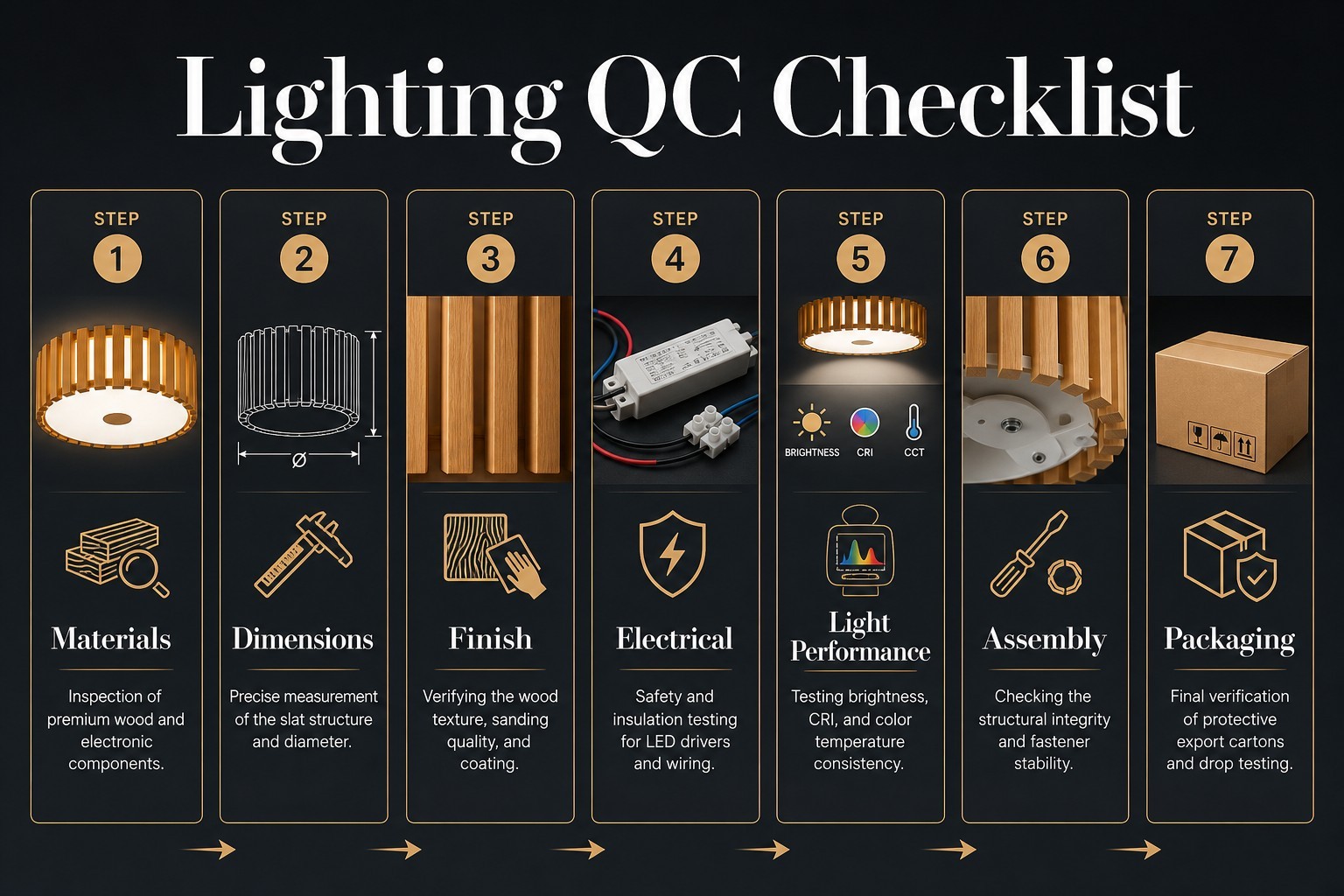
What Should Be Included in a Lighting QC Checklist?
A useful lighting quality control checklist should include measurable requirements rather than general statements such as "good quality."
A basic checklist can include:
QC Area | What to Check |
|---|---|
Dimensions | Size, weight, mounting points |
Materials | Metal, glass, acrylic, wood, fabric |
Finish | Color, gloss, texture, coating |
Electrical | Voltage, wattage, driver, wiring |
Light Performance | CCT, CRI, lumens, dimming |
Assembly | Alignment, screws, wiring, structure |
Appearance | Scratches, dents, cracks, defects |
Accessories | Screws, brackets, cables, manuals |
Packaging | Inner protection and carton strength |
Labeling | Logo, model, ratings, barcode |
Documentation | Specifications, test reports, certifications |
The checklist should be agreed upon by the buyer and supplier before production.
Should Buyers Inspect Every Lighting Product?
Not necessarily. The inspection method depends on the order size, product type, risk level, and buyer's quality requirements.
For large wholesale orders, buyers commonly use sampling-based inspection rather than opening and testing every individual product.
A quality inspection may be performed:
Before production
During production
After production
Before shipment
For higher-risk or highly customized products, buyers may require more extensive inspection.
The key is to define what will be inspected, how it will be measured, and what constitutes an acceptable or unacceptable result before production starts.
How Can Buyers Prevent Quality Problems Before Production?
The most effective approach is to establish clear specifications before placing the bulk order.
A buyer should provide or confirm:
Approved product sample
Product drawings or dimensions
Material requirements
Electrical specifications
Color and finish reference
Packaging requirements
Branding requirements
Certification requirements
Inspection criteria
Acceptable tolerances
This creates a clear reference for both the buyer and manufacturer.
What Questions Should You Ask a Lighting Manufacturer About Quality Control?
Before starting bulk production, ask the manufacturer:
Does the factory provide a pre-production sample?
Confirm whether you can approve a final sample before mass production begins.
What quality standards do you use during production?
Ask how the factory controls materials, assembly, electrical components, and finished products.
Can you provide product inspection reports?
For applicable orders, ask whether inspection records or quality-control reports can be provided.
How are defective products handled?
Confirm the supplier's process for identifying, replacing, repairing, or resolving defective units.
Can you follow our inspection checklist?
If you have specific requirements, provide them to the manufacturer before production.
Quality Control for OEM and ODM Lighting
OEM and ODM projects require additional quality-control attention because the product may be customized specifically for one buyer.
For customized lighting, buyers should pay particular attention to:
Approved drawings
Prototype samples
Material specifications
Color references
Electrical components
Custom tooling
Logo placement
Packaging artwork
Product labeling
Final pre-production sample
The approved sample should become the reference point for bulk production.
This is especially important when a product has multiple customized components or when the buyer plans to sell the same product under a private label.
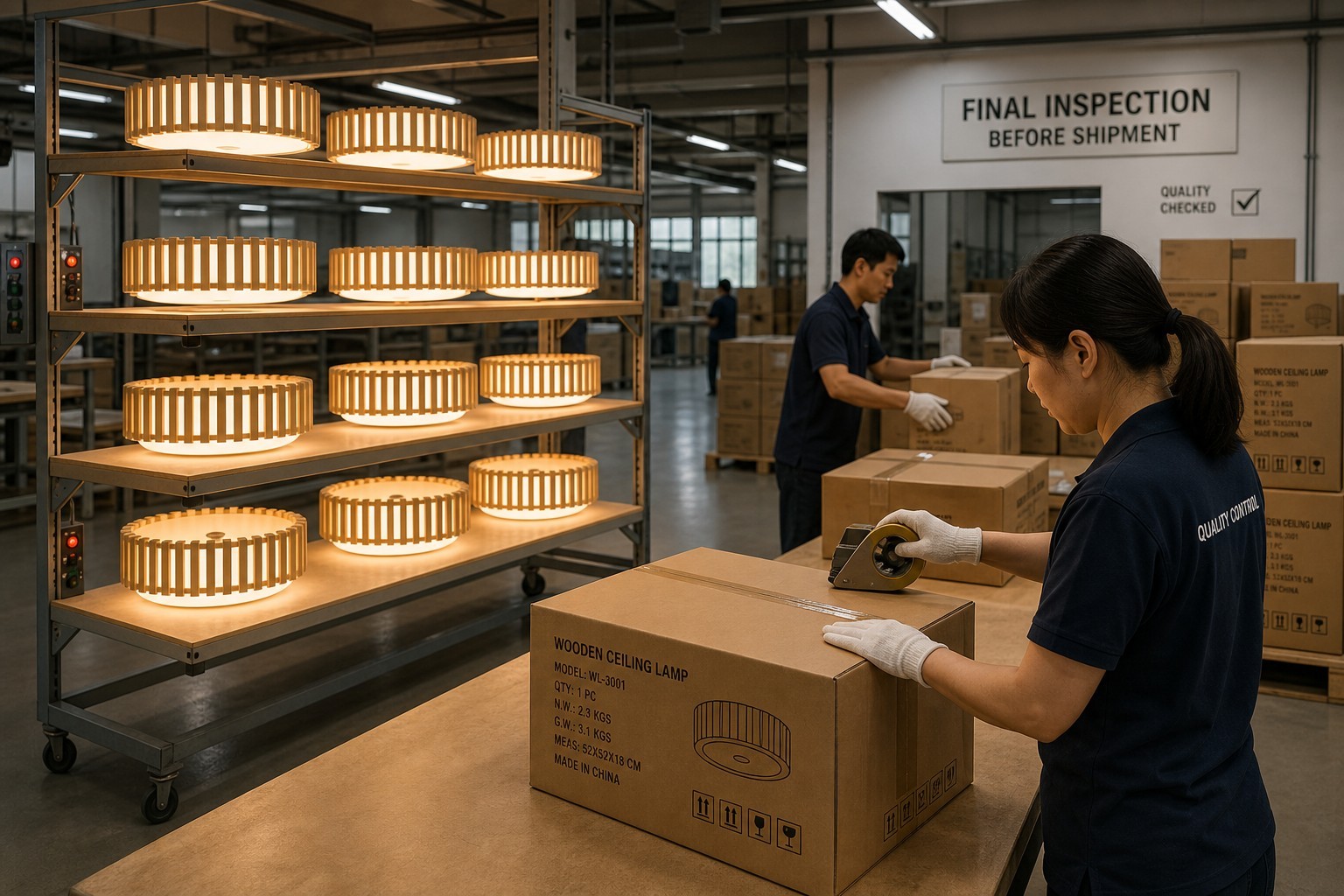
Final Checklist Before Approving Bulk Production
Before giving a lighting manufacturer approval to begin mass production, make sure you have confirmed:
☐ Product dimensions
☐ Materials and components
☐ Color and finish
☐ Electrical specifications
☐ Light performance
☐ Assembly quality
☐ Mounting accessories
☐ Packaging
☐ Product labels
☐ Branding
☐ Certifications and documentation
☐ Pre-production sample
Once these details are confirmed, the risk of costly production mistakes can be significantly reduced.
Final Thoughts
Good lighting quality control starts before bulk production, not after the products leave the factory.
The most effective approach is to establish clear product specifications, approve a final sample, define inspection criteria, and confirm packaging and documentation requirements before mass production begins.
For wholesale, OEM, and ODM lighting projects, buyers should evaluate more than appearance. Materials, dimensions, electrical performance, workmanship, compliance, packaging, and consistency all contribute to the final product quality.
A clear quality-control process helps both buyers and manufacturers reduce misunderstandings, minimize production risks, and build more reliable long-term business relationships.
Learn more about the complete sourcing process in our How to Import Lighting Products from China guide.