
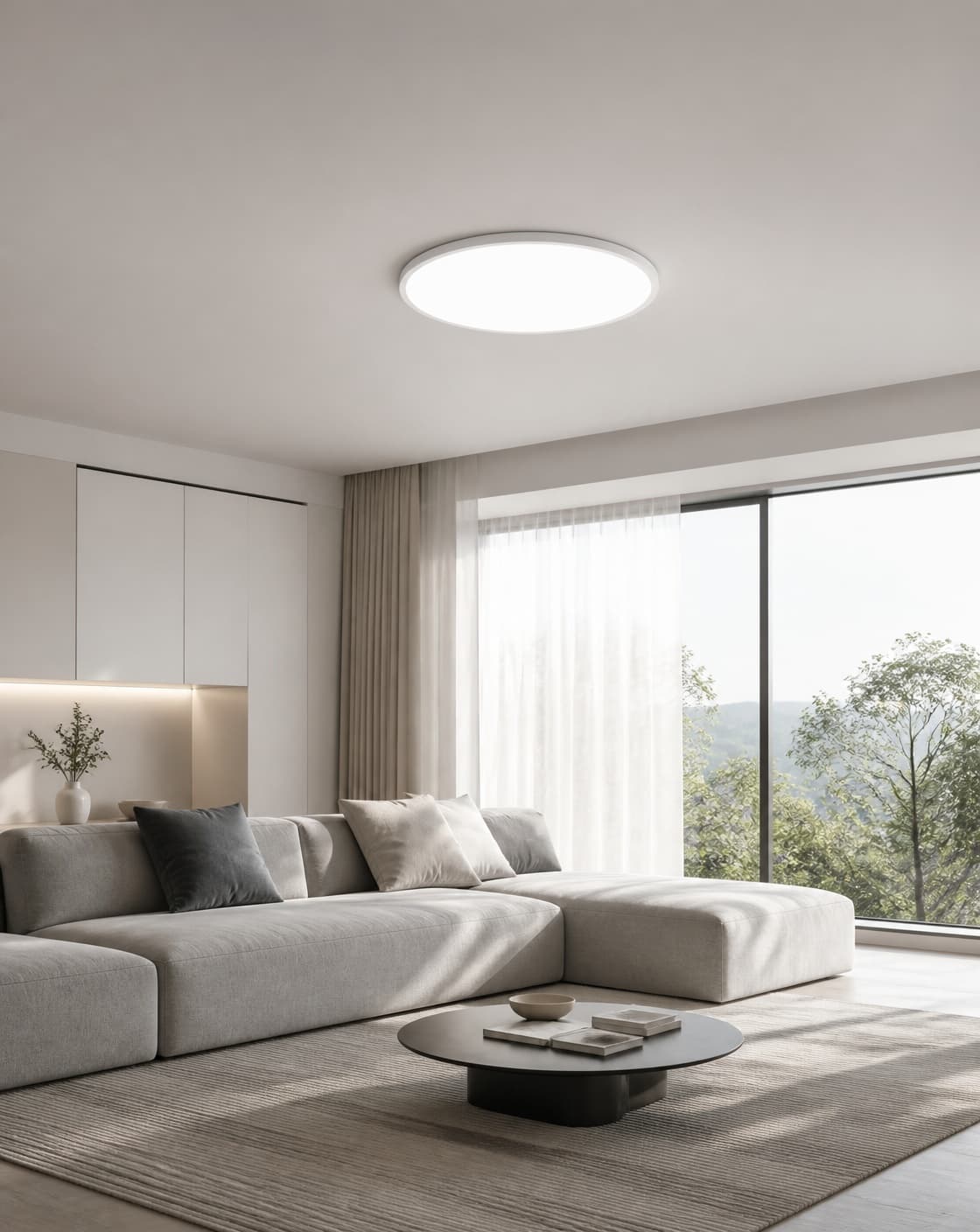
Low Ceiling & Flush Mount Lights: Will a Ceiling Light Make a 2.6–2.8m Room Feel Cramped?
A ceiling height of 2.6–2.8 meters (8.5–9.2 ft) is common in apartments, bedrooms, studies, dining rooms, and modern residential projects.
But homeowners, interior designers, and lighting buyers often have the same concern:
Will installing a ceiling light make a relatively low room feel even more cramped?
The short answer is: not if you choose the right flush mount ceiling light.
For rooms with a 2.6–2.8m ceiling, the key is not simply choosing the smallest light. Instead, you should consider the fixture thickness, diameter, visual proportions, light distribution, and installation position.
In this guide, we explain how to choose flush mount LED ceiling lights for low and standard-height rooms.
1. Is a 2.6–2.8m Ceiling Considered Low?
A ceiling height of 2.6–2.8m is not necessarily "too low."
It is better described as a standard or relatively modest residential ceiling height, especially in apartments and compact homes.
The important point is that a ceiling light hangs below the ceiling. The thicker the fixture, the more it visually occupies the upper part of the room.
For example:
2.6m ceiling + thick pendant light: May create a more enclosed feeling.
2.6m ceiling + slim flush mount: Usually feels clean and unobtrusive.
2.8m ceiling + slim LED ceiling light: Generally provides plenty of visual clearance.
2.8m ceiling + large decorative pendant: Can work well when the room layout allows sufficient clearance.
This is why flush mount and ultra-slim ceiling lights are often preferred for lower ceilings.
2. How Thick Should a Ceiling Light Be for a 2.6–2.8m Ceiling?
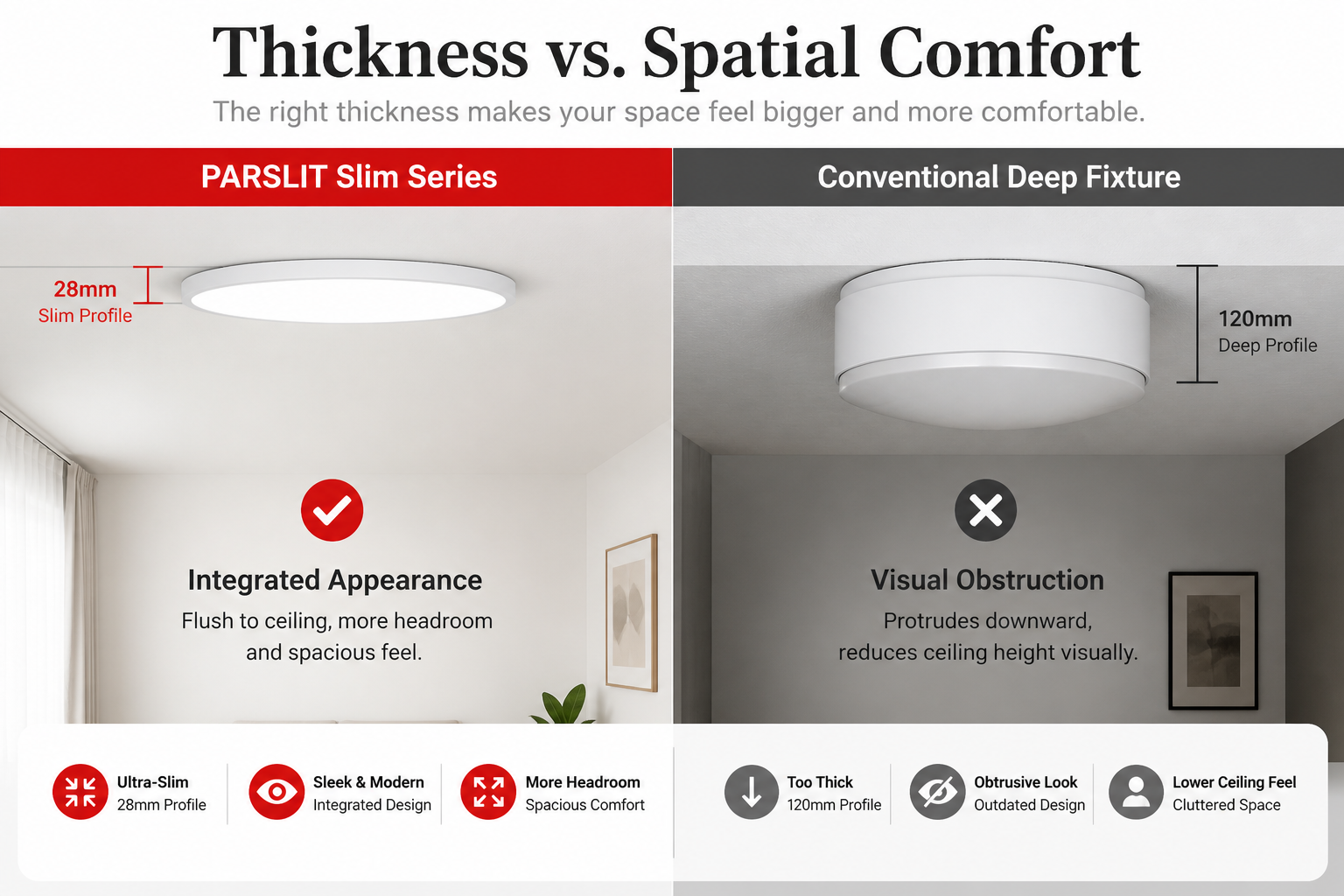
Fixture thickness is one of the most important specifications to check.
For a low or standard-height room, a practical guideline is:
Ceiling Height | Recommended Fixture Profile |
|---|---|
2.5–2.6m | Preferably 30–60mm |
2.6–2.8m | Around 35–70mm |
2.8–3.0m | Around 40–90mm |
Above 3.0m | More freedom in fixture thickness |
These are general design guidelines rather than strict rules.
For most bedrooms, studies, small dining areas, and apartments with 2.6–2.8m ceilings, a ceiling light with a relatively slim profile will help maintain a more spacious appearance.
Why does thickness matter?
Imagine two ceiling lights with the same diameter:
Light A: 50mm thick
Light B: 120mm thick
Even though their diameters may be identical, Light B visually extends much further into the room.
In a compact room, this additional visual volume can make the ceiling appear lower.
A slim fixture, on the other hand, stays closer to the ceiling and creates a cleaner transition between the ceiling and the light.
3. Does a Larger Ceiling Light Make the Room Feel More Crowded?
Not necessarily.
This is one of the most common misunderstandings when choosing ceiling lights.
A large-diameter but ultra-slim ceiling light can actually look more balanced than a small but thick fixture.
For example:
400mm diameter × 45mm thick
This type of fixture can provide a broad visual surface while maintaining a low profile.
300mm diameter × 100mm thick
Although physically smaller, the deeper body can create more visual weight.
Therefore, when evaluating a ceiling light, don't look at diameter alone.
Consider these specifications together:
Diameter + Thickness + Ceiling Height + Room Size
4. Recommended Ceiling Light Sizes for Different Room Areas
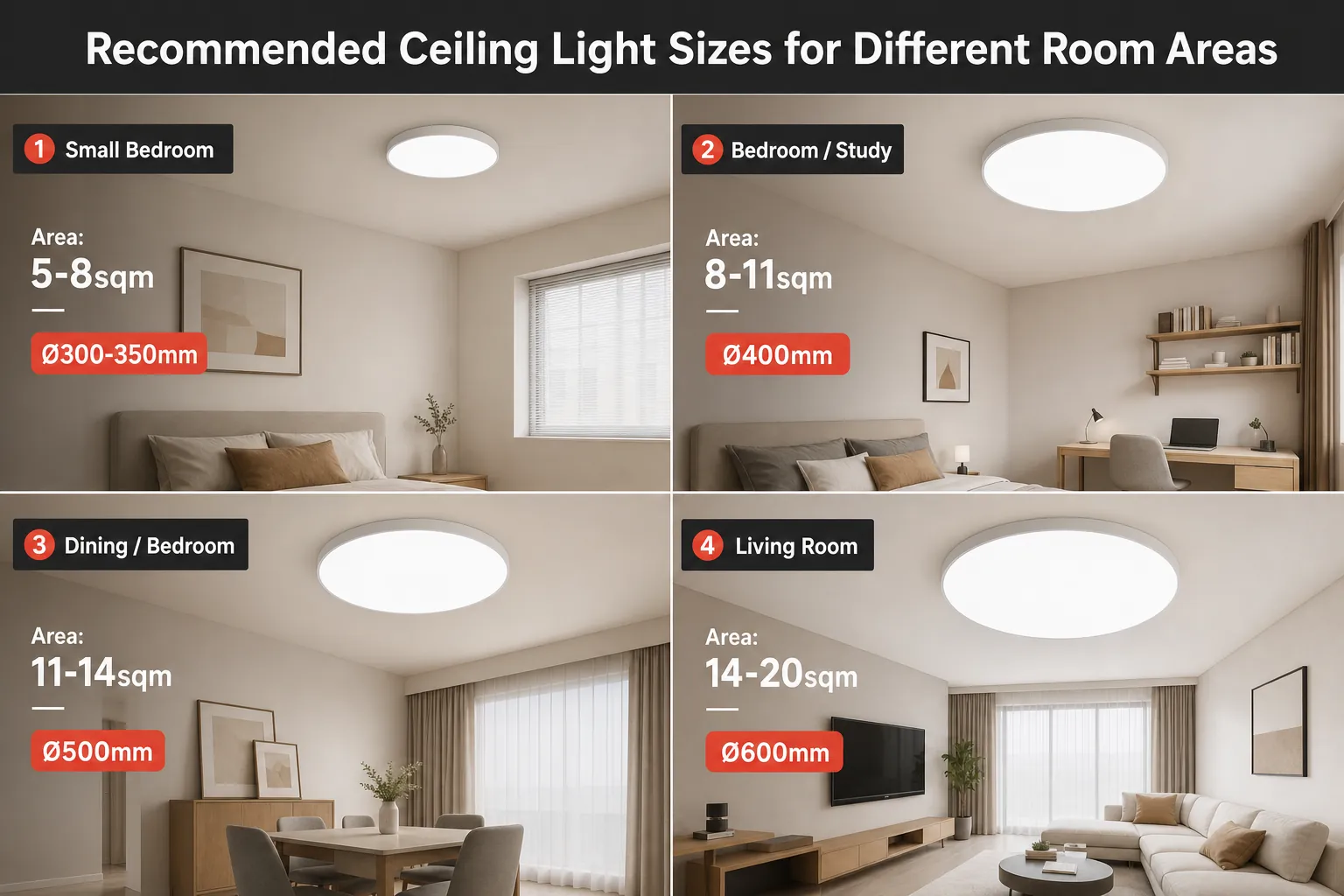
Choosing the right diameter is equally important.
A fixture that is too small may look insignificant, while an oversized fixture can dominate a compact room.
Here is a practical starting point:
Ceiling Light Diameter | Recommended Room Area | Typical Applications |
|---|---|---|
Ø300–350mm | 5–8 m² | Small bedroom, hallway, study |
Ø400mm | 8–11 m² | Bedroom, study, small dining area |
Ø500mm | 11–14 m² | Bedroom, dining room, study, apartment |
Ø600mm | 14–20 m² | Living room, larger bedroom, dining room |
Ø700mm+ | 20 m²+ | Large living areas, open-plan spaces |
The exact size should also depend on the required brightness, ceiling layout, furniture arrangement, and lighting design.
5. What Type of Ceiling Light Looks Best in a Low Ceiling Room?
For 2.6–2.8m ceilings, several types of ceiling lights work particularly well.
5.1 Ultra-Slim LED Ceiling Lights
Ultra-slim LED ceiling lights are one of the safest choices for low ceilings.
Their compact profile sits close to the ceiling and minimizes the visual drop.
They are especially suitable for:
Bedrooms
Studies
Apartments
Small dining rooms
Children's rooms
Corridors
Compact living rooms
The clean, flat appearance also works well with modern and minimalist interiors.
5.2 Flush Mount Ceiling Lights
Flush mount lights are installed directly against the ceiling rather than suspended from a long stem or cable.
This makes them particularly suitable when ceiling height is limited.
For residential projects with 2.6–2.8m ceilings, a flush mount design can provide:
Low visual impact
Efficient space utilization
Even illumination
Easy installation
Modern appearance
5.3 Integrated LED Ceiling Lights
Integrated LED ceiling lights combine the LED light source and fixture into one compact structure.
Compared with traditional bulbs and bulky shades, integrated LED designs can achieve a slimmer overall profile.
For B2B lighting projects, integrated LED structures can also provide opportunities for customization in:
Wattage
Color temperature
Diameter
Housing material
Diffuser
Dimming
Sensor functions
Color rendering performance
6. Can a Ceiling Light Make a Room Feel "Shorter"?
Yes—but the effect is usually caused by visual proportion, rather than the actual fixture height alone.
Several factors can make a room feel visually lower:
1. Excessive fixture thickness
A deep fixture occupies more vertical space.
2. Dark or heavy housing
Dark, bulky designs can create stronger visual weight.
3. Oversized decorative structures
Large decorative elements may visually pull the ceiling downward.
4. Poor installation proportions
A fixture that is too large for a small room can dominate the ceiling.
5. Uneven lighting
Dark corners and insufficient ceiling illumination can also make a room feel smaller.
This means choosing a ceiling light is not simply about "how thin is the lamp?"
It is about how the entire lighting system interacts with the room.
7. What Makes a Slim Ceiling Light Look Even Lighter?
If the goal is to make a 2.6–2.8m room feel open and comfortable, several design details can help.
Low-Profile Housing
A compact housing reduces the distance between the ceiling and the bottom of the fixture.
Wide Diffusing Surface
A broad diffuser can distribute light across a larger area without requiring a bulky structure.
Simple Circular or Square Geometry
Clean geometric shapes tend to create less visual clutter.
Light-Colored Housing
White or neutral-colored housings can blend more naturally with white ceilings.
Uniform Light Distribution
A well-designed LED diffuser can provide smooth illumination without strong dark areas.
8. Is a Round or Square Ceiling Light Better for Low Ceilings?
Both can work well.
The choice usually depends more on the interior style and room layout than on ceiling height.
Round Ceiling Lights
Round fixtures are suitable for:
Bedrooms
Dining areas
Studies
Apartments
Modern residential interiors
They create a soft and visually continuous appearance.
Square Ceiling Lights
Square fixtures are suitable for:
Modern minimalist interiors
Rectangular rooms
Offices
Studies
Contemporary residential projects
They can align naturally with walls and furniture.
For low ceilings, both round and square flush mount designs can work effectively when the fixture has a slim profile.
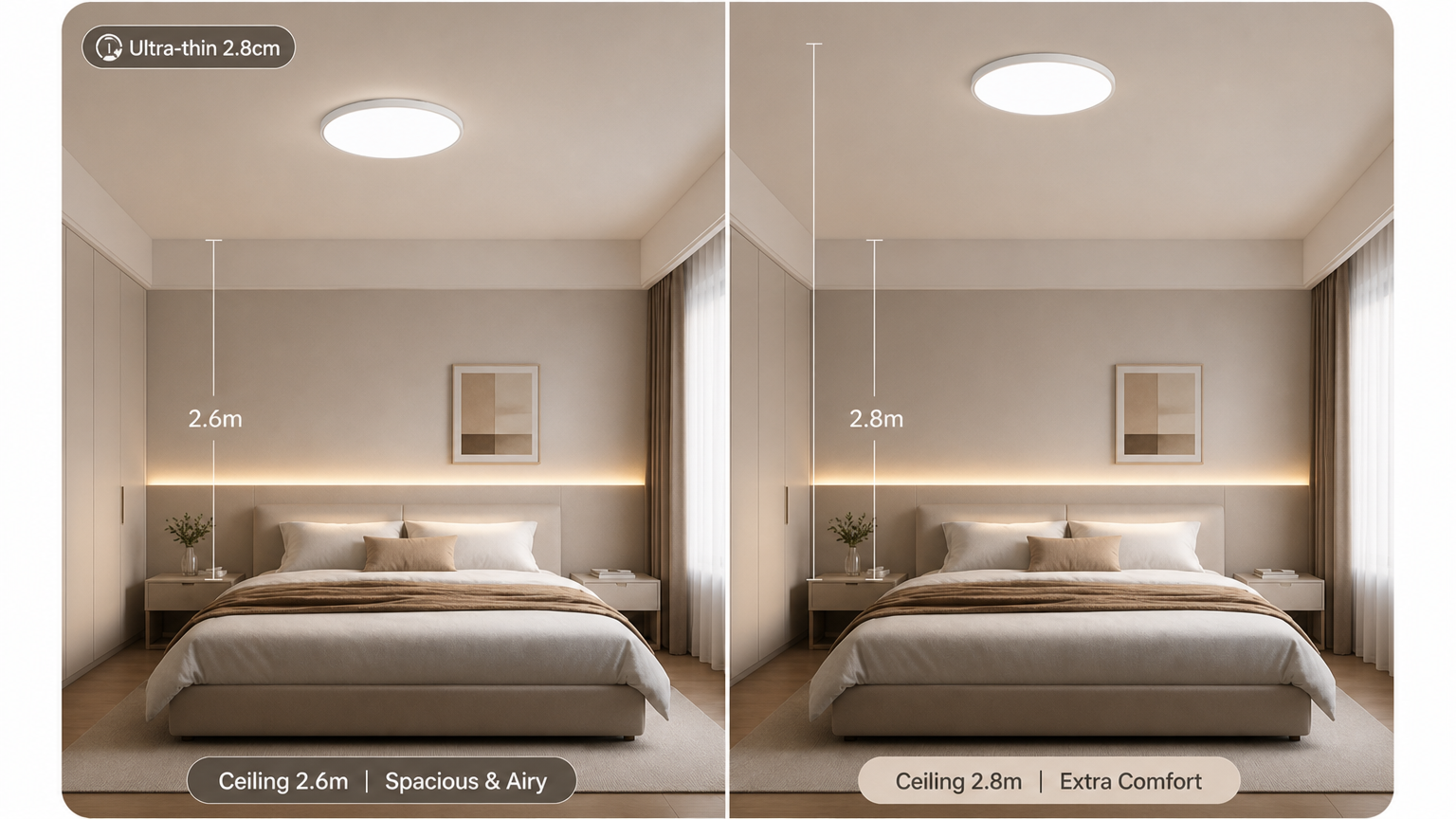
9. What About a 2.6m Ceiling? A Practical Example
Let's take a bedroom with:
Ceiling height: 2.6m
Room area: 10 m²
A practical choice could be:
Diameter: Ø400–500mm
Fixture thickness: approximately 40–60mm
Installation: Flush mount
Light source: Integrated LED
Diffuser: High-transmission diffuser
Color temperature: 3000K–4000K depending on the desired atmosphere
The goal is to provide sufficient illumination without creating unnecessary visual bulk.
A very thick ceiling fixture may make the upper part of the room feel heavier, while an ultra-slim design can maintain a cleaner ceiling line.
10. What About a 2.8m Ceiling?
With a 2.8m ceiling, there is slightly more freedom.
For example, a bedroom or dining room can accommodate:
Ø400mm
Ø500mm
Ø600mm
depending on room size and lighting requirements.
A fixture around 40–70mm thick can generally maintain a relatively low-profile appearance.
However, room size still matters.
A 600mm ceiling light may look appropriate in a 16–20 m² living room but oversized in a 7 m² bedroom.
11. Don't Choose a Ceiling Light Based on Thickness Alone
A common mistake is to compare ceiling lights only by their physical thickness.
For B2B lighting projects, buyers should also consider the internal construction.
A ceiling light with a thin appearance should still have sufficient space for:
LED modules
Driver
Thermal management
Electrical connections
Diffuser
Mounting structure
An extremely thin product is not automatically better if thermal performance, driver reliability, or light distribution is compromised.
For manufacturers and project buyers, low profile + reliable construction is a better combination than simply pursuing the smallest thickness.
12. How to Choose a Ceiling Light for a 2.6–2.8m Ceiling
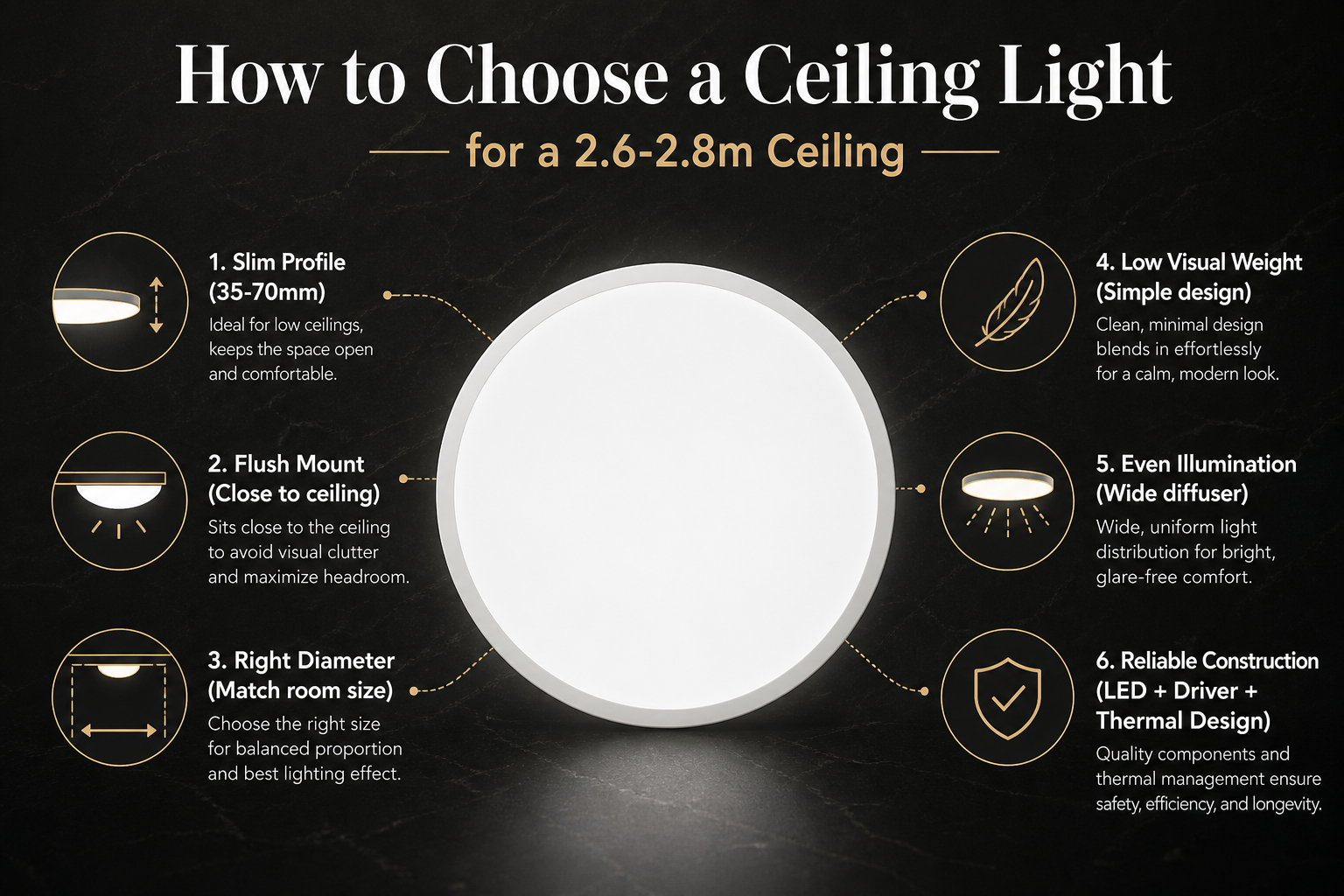
If your project has a ceiling height between 2.6m and 2.8m, use this checklist:
✓ Choose a flush mount design
Keep the fixture close to the ceiling.
✓ Prefer a slim profile
Around 35–70mm is a useful starting range for many residential applications.
✓ Match the diameter to the room
Don't choose the largest available size simply because more light seems better.
✓ Consider visual weight
White, simple, minimalist designs generally blend better with light-colored ceilings.
✓ Check light distribution
A larger diffuser and well-designed LED system can provide broad illumination without excessive fixture depth.
✓ Consider glare control
A comfortable ceiling light should provide sufficient brightness without producing uncomfortable glare.
✓ Check the driver and thermal design
For B2B purchasing, electrical reliability is just as important as appearance.
13. For Lighting Buyers: What Specifications Should You Ask the Manufacturer?
When sourcing ceiling lights for apartments, residential developments, hotels, or other projects, don't ask only:
"How thick is the light?"
A better specification request includes:
Overall diameter
Overall fixture thickness
Net weight
LED wattage
Lumens
Color temperature
CRI
Beam angle
Driver brand or driver specifications
Dimming options
Input voltage
Material
Diffuser material
IP rating
Installation method
Certifications
Available customization
Packaging dimensions
This gives buyers a much better understanding of whether a ceiling light is suitable for a specific project.
Final Takeaway
For a 2.6–2.8m ceiling, installing a ceiling light does not automatically make a room feel cramped.
The key is to choose a fixture with the right profile, diameter, visual weight, and light distribution.
For most residential applications, a slim flush mount LED ceiling light with a profile of approximately 35–70mm can provide a good balance between appearance, illumination, and available vertical space.
Instead of asking:
"How small should the ceiling light be?"
A better question is:
"How can the ceiling light provide enough illumination while taking up as little visual space as possible?"
That is the real principle behind choosing ceiling lights for low and standard-height rooms.
Looking for Slim Flush Mount LED Ceiling Lights for Your Project?
PARSLIT supplies LED lighting solutions for residential, hospitality, commercial, and project applications.
For B2B buyers, we can support customization of diameter, wattage, color temperature, CRI, driver, diffuser, housing, packaging, and other specifications according to project requirements.
If you are sourcing ceiling lights for apartments, bedrooms, hotels, or residential developments, choosing the right fixture profile at the beginning of the project can make a significant difference to both lighting performance and interior appearance.