
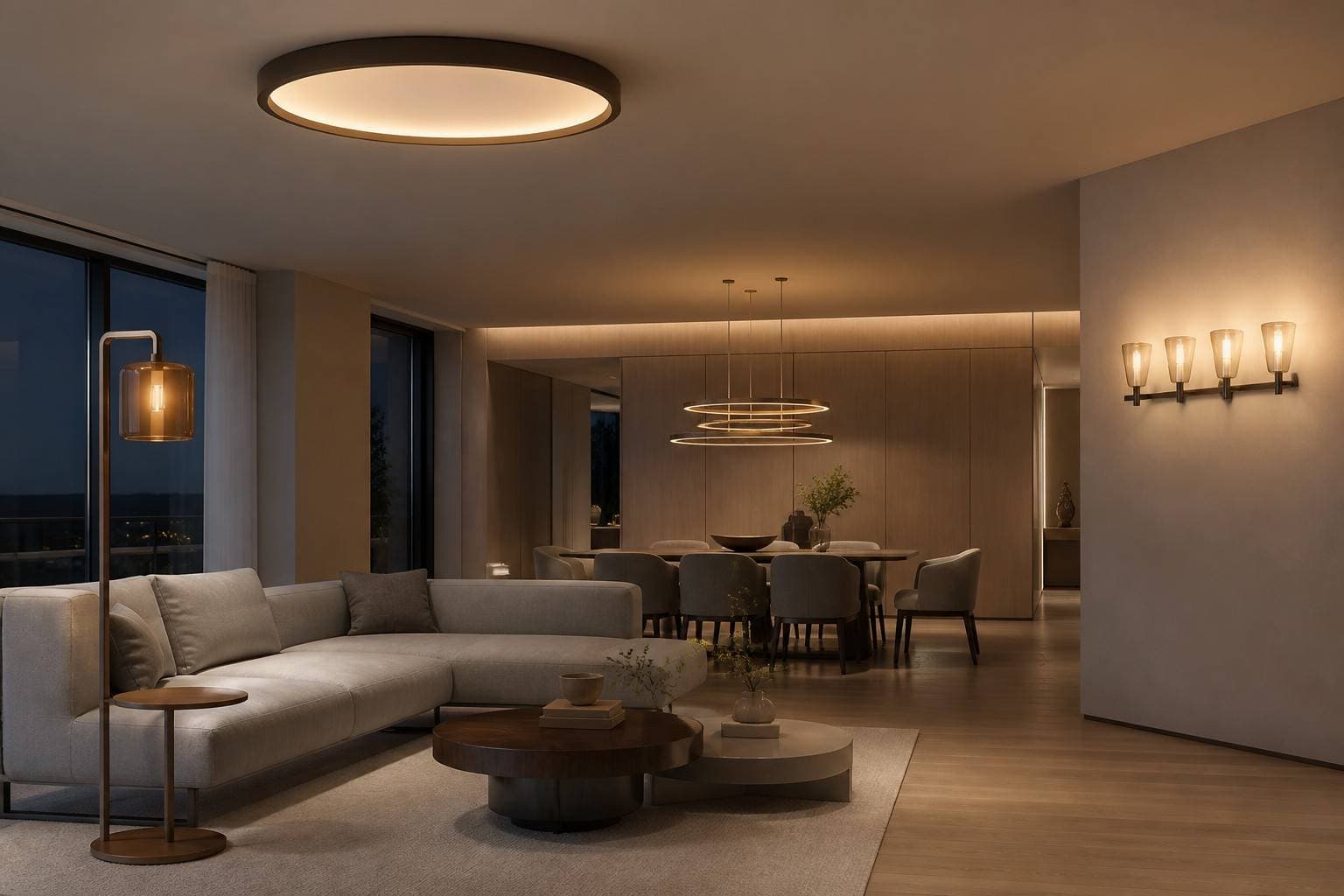
2026 Whole-Home Lighting Guide: How to Choose Ceiling, Pendant, Wall & Table Lamps
Lighting is one of the most important elements in a home, yet it is often one of the last things people think about when planning a renovation.
The right lighting can make a room feel larger, warmer, more comfortable and more functional. The wrong lighting can make even a beautifully designed space feel flat, harsh or uncomfortable.
In 2026, residential lighting is moving beyond the traditional idea of using one central ceiling light for an entire room. Instead, homeowners are increasingly combining ambient lighting, task lighting and accent lighting to create flexible and layered lighting environments.
But how do you know which type of light is right for each room?
This complete whole-home lighting guide explains how to choose ceiling lights, pendant lights, wall lights and table lamps, as well as the key lighting specifications you should understand before buying.
1. Start With the Three Layers of Home Lighting
Before choosing a fixture based on its appearance, think about what the light needs to do.
A well-designed home lighting plan usually combines three basic layers.
Ambient Lighting
Ambient lighting provides the general illumination of a room.
Common examples include:
Recessed lighting
Linear ceiling lights
Ambient lighting is usually the foundation of a room's lighting plan.
Task Lighting
Task lighting provides focused illumination for specific activities.
Examples include:
Reading
Working at a desk
Cooking
Applying makeup
Getting dressed
Eating
Table lamps, wall lights, mirror lights and pendant lights can all be used as task lighting depending on their design and position.
Accent & Decorative Lighting
Accent lighting adds visual depth and highlights specific areas of a room.
It can be used to:
Highlight artwork
Create a focal point
Illuminate architectural details
Add depth to a wall
Create a relaxing evening atmosphere
The basic idea is simple:
Ambient lighting helps you see. Task lighting helps you perform specific activities. Accent lighting adds atmosphere and visual depth.
Using these three layers together can create a more comfortable and flexible home lighting environment.
2. How to Choose Ceiling Lights
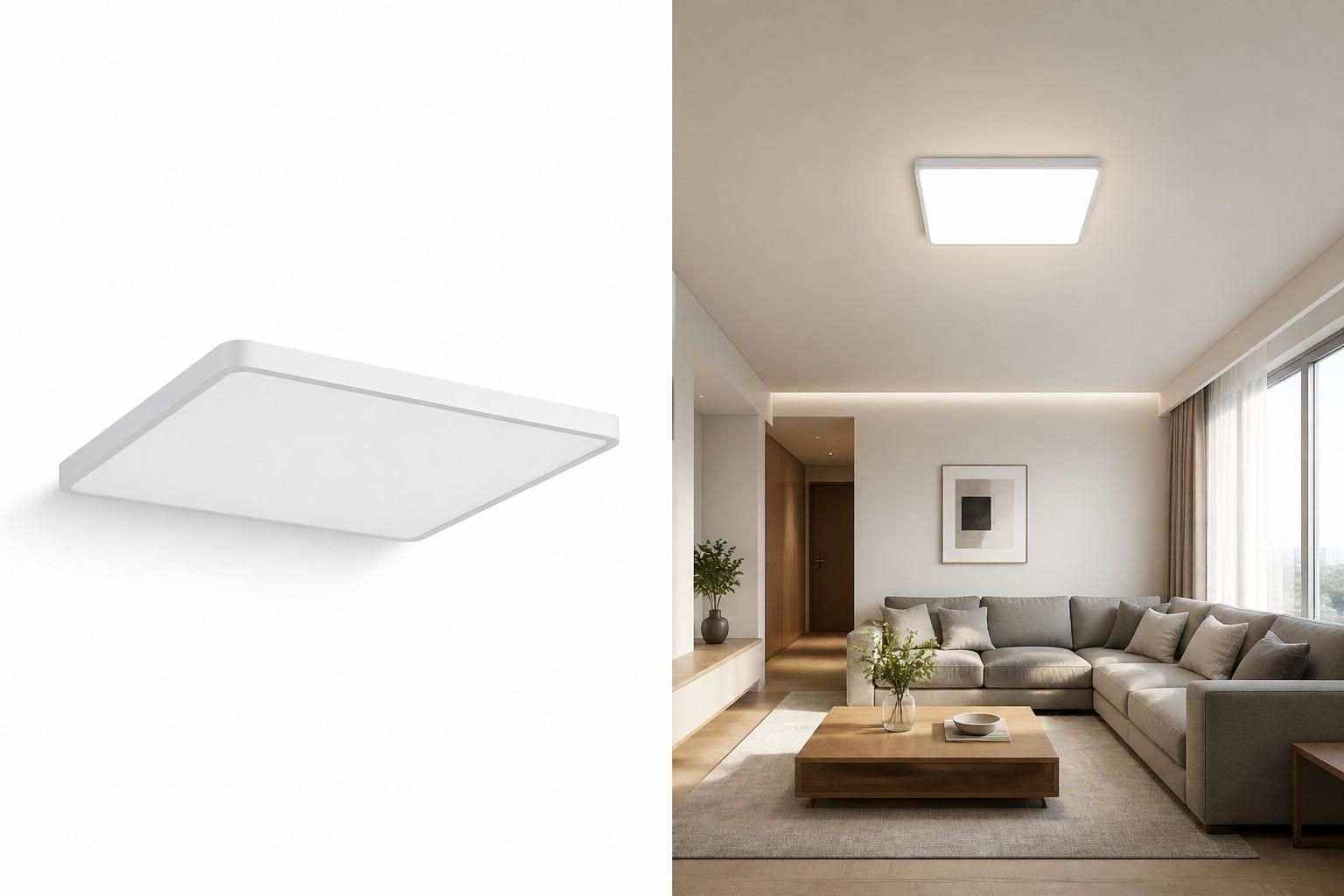
Ceiling lights are one of the most practical lighting choices for residential spaces.
Because they sit close to the ceiling, they are particularly suitable for rooms where you want to maximize the feeling of space.
Ceiling lights are ideal for:
Living rooms
Bedrooms
Dining rooms
Home offices
Hallways
Entryways
Apartments
Rooms with lower ceilings
Why choose a ceiling light?
A well-designed LED ceiling light can provide broad, even illumination without taking up much visual space.
This makes flush mount and slim ceiling lights especially useful in modern apartments and homes with relatively low ceilings.
What should you look for?
Size
The fixture should be proportional to the room.
A light that is too small may not provide sufficient visual presence or illumination, while an oversized fixture can dominate a small room.
Consider:
Room size
Ceiling height
Furniture dimensions
Light output
Overall interior style
Light Distribution
Look for a fixture that distributes light evenly throughout the room rather than creating a very bright spot directly underneath the fixture.
A good diffuser and well-designed LED layout can help produce softer and more uniform illumination.
Dimming
Dimmable ceiling lights are particularly useful in multifunctional spaces.
For example, a living room may need brighter light during the day but a softer setting in the evening.
3. How to Choose Pendant Lights
Pendant lights are more than a source of illumination.
They can also become a major visual feature in a room.
Unlike flush mount ceiling lights, pendant lights hang down from the ceiling and naturally draw attention to a specific area.
Pendant lights work especially well above:
Dining tables
Kitchen islands
Breakfast bars
Coffee tables
Living room seating areas
Entryways
Pendant lights for dining rooms
A pendant light above a dining table helps define the dining area and creates a more intimate atmosphere.
For a long dining table, a linear pendant light can provide more consistent illumination across the entire surface.
Pendant lights for kitchen islands
Kitchen islands often benefit from focused lighting.
Depending on the island size, you can use:
One large pendant
Two or three smaller pendants
A linear pendant light
The key is to maintain visual balance between the fixture and the island.
How large should a pendant light be?
A commonly used starting point is:
Room length in feet + room width in feet ≈ fixture diameter in inches
For example, a 12 ft × 10 ft room gives:
12 + 10 = 22
A fixture around 22 inches in diameter can be a starting point for consideration.
This is only a guideline. Furniture size, ceiling height and the visual weight of the fixture should also be considered.
4. How to Choose Wall Lights
One common lighting problem in modern homes is relying entirely on ceiling-mounted fixtures.
The ceiling may be bright, but the walls can remain visually dark.
Wall lights can help solve this problem by adding light at eye level and creating another layer of illumination.
Wall lights are ideal for:
Bedrooms
Living rooms
Hallways
Entryways
Bathrooms
Stairways
Accent walls
Bedroom wall lights
Wall-mounted bedside lights can be an excellent alternative to traditional bedside lamps.
They are particularly useful in smaller bedrooms because they free up space on the nightstand.
For reading, choose a design that provides sufficiently focused light and, where possible, allows the direction of the light to be adjusted.
Bathroom wall lights
Mirror lighting is another important application.
A light placed only above a mirror can create shadows underneath the eyes, nose and chin.
Adding lighting near the sides of the mirror can provide more balanced facial illumination.
Pay attention to light direction
Wall lights can provide:
Upward light
Downward light
Up-and-down light
Forward light
Diffused light
The right option depends on whether the fixture is being used primarily for decoration, general illumination or a specific task.
5. How to Choose Table Lamps
Table lamps are one of the most flexible lighting solutions in a home.
Unlike built-in lighting, they can be moved or replaced without changing the electrical layout of the room.
Table lamps work well on:
Bedside tables
Desks
Side tables
Console tables
Entryway cabinets
Living room cabinets
Reading corners
A table lamp can create a small, comfortable pool of light without requiring the main ceiling light to remain on.
Table lamps for bedrooms
For bedrooms, look for:
Warm color temperatures
Soft diffusion
Low glare
Dimming capability
Appropriate light output
If the lamp is mainly used for reading, a more directional design can help place light where it is needed without shining directly into your eyes.
6. Room-by-Room Whole-Home Lighting Guide
The best way to plan home lighting is not to choose one fixture for each room.
Instead, think about the activities that take place in each space and combine different types of lighting accordingly.
Living Room Lighting
A practical combination is:
Ceiling Light or Pendant Light + Wall Light + Table or Floor Lamp
The ceiling fixture provides general illumination.
Wall lights and table or floor lamps add softer secondary lighting.
For larger living rooms, additional accent lighting can be used to highlight artwork, shelving or architectural features.
Recommended color temperature
2700K–3000K
Warm white light generally works well for comfortable residential living spaces.
Bedroom Lighting
The bedroom should prioritize comfort rather than maximum brightness.
A practical combination is:
Ceiling Light + Bedside Wall Light or Table Lamp
For bedrooms used for reading, dedicated bedside task lighting can provide better control than relying only on the main ceiling fixture.
Recommended color temperature
2700K–3000K
Warmer light is generally more suitable for relaxing evening environments.
Dining Room Lighting
The dining table should normally be the visual center of the room.
A pendant light or chandelier above the table can provide both functional and decorative lighting.
For longer tables, consider a linear pendant or multiple pendants to distribute light more evenly.
Recommended features
Dimmable lighting
Comfortable color temperature
Appropriate fixture scale
Good light distribution
Low glare
Kitchen Lighting
Kitchen lighting needs to balance general illumination with task lighting.
A useful combination is:
Ceiling Lighting + Under-Cabinet Lighting + Pendant Lighting
Ceiling lighting provides general illumination.
Under-cabinet lighting helps illuminate countertops and reduce shadows caused by overhead fixtures.
Pendant lights can provide focused lighting above a kitchen island or breakfast bar.
Recommended color temperature
3000K–4000K
The ideal choice depends on the kitchen design, finishes and the lighting used in adjacent spaces.
Home Office Lighting
A home office requires more functional lighting than a bedroom or living room.
A practical setup is:
Ceiling Light + Desk Lamp
The ceiling light provides general illumination while the desk lamp provides focused task lighting.
Avoid positioning the desk lamp where it creates strong reflections on your computer screen.
For long working sessions, comfortable, well-diffused light and good glare control are more important than simply increasing brightness.
Bathroom Lighting
Bathrooms need both general and task lighting.
A good combination is:
Ceiling Light + Mirror Light or Wall Lights
Mirror lighting is particularly important for activities such as shaving, skincare and makeup.
When choosing bathroom lighting, also consider the fixture's suitability for the installation environment and the appropriate electrical safety requirements.
Hallway & Entryway Lighting
Hallways usually do not need extremely high light output.
A combination of:
Slim ceiling lights
Wall lights
Motion-sensor lighting
can provide comfortable illumination while keeping the space visually clean.
7. Lumens, Watts, Kelvin and CRI: The Four Lighting Specs You Should Know
When shopping for LED lighting, many people focus on wattage.
However, wattage alone does not tell you how much light a modern LED fixture produces.
There are four important specifications to understand.
Lumens: How Much Light Does the Fixture Produce?
Lumens (lm) measure the amount of visible light produced by a light source.
In simple terms:
Higher lumens generally mean more light output.
When comparing LED fixtures, compare lumens rather than simply comparing wattage.
Watts: How Much Energy Does It Use?
Watts (W) measure electrical power consumption.
Two LED fixtures can have the same wattage but produce different amounts of light depending on their efficiency.
Therefore:
Do not use wattage alone to judge brightness.
Kelvin: What Color Will the Light Look Like?
Kelvin (K) describes the color temperature of the light.
Color Temperature | Appearance | Typical Applications |
|---|---|---|
2200K–2700K | Very warm | Bedrooms, bedside lighting, relaxing spaces |
2700K–3000K | Warm white | Living rooms, bedrooms, dining rooms |
3000K–4000K | Neutral white | Kitchens, bathrooms, offices |
4000K+ | Cooler white | Work-focused or specialized areas |
There is no single color temperature that is perfect for every room.
The goal is to choose a color temperature that matches the function and atmosphere of the space.
CRI: How Naturally Do Colors Appear?
CRI (Color Rendering Index) describes how accurately a light source reveals colors compared with a reference light source.
High-CRI lighting can be especially valuable in areas where accurate color appearance matters.
Consider higher-CRI lighting for:
Kitchens
Bathrooms
Dressing areas
Makeup areas
Walk-in closets
Art displays
For many residential applications, CRI 90+ is a useful specification to look for when color quality is important.
8. Why Dimmable Lighting Matters in 2026
Modern homes often use the same room for several different activities.
A living room might be used for:
Working
Reading
Dining
Watching movies
Entertaining guests
Relaxing
One fixed brightness level cannot provide the ideal atmosphere for every situation.
Dimmable lighting allows you to adjust the light according to the time of day and activity.
For example:
Daytime: Brighter general lighting
Dinner: Moderate lighting focused around the dining area
Movie night: Lower ambient lighting with accent lights
Before bed: Soft, warm illumination
For homeowners looking for more flexibility, features such as dimming and adjustable color temperature can be valuable considerations when selecting LED fixtures.
9. Common Home Lighting Mistakes to Avoid
Mistake 1: Using Only One Central Light
A single ceiling fixture may provide enough brightness, but the room can still feel flat.
Adding wall lights, table lamps or other secondary sources creates more visual depth.
Mistake 2: Using Cool White Light Everywhere
Cooler light can be useful in task-oriented areas, but using it throughout bedrooms and living spaces may create a less relaxing atmosphere.
Mistake 3: Choosing Fixtures Based Only on Wattage
Always check the lumen output and other specifications instead of judging brightness by wattage alone.
Mistake 4: Ignoring CRI
Poor color rendering can affect how furniture, fabrics, flooring and wall colors appear.
Mistake 5: Ignoring Glare
A fixture can look beautiful but still be uncomfortable if the LED source is directly visible.
When choosing lighting, consider:
Diffuser design
Shielding
Beam angle
Light distribution
Glare control
Mistake 6: Mixing Too Many Color Temperatures
Using several different color temperatures within the same visual area can make a room feel inconsistent.
For example, combining very warm bedside lighting with cool ceiling lighting and neutral wall lights may create an uncomfortable visual contrast.
Choose color temperatures as part of the overall lighting plan rather than selecting each fixture independently.
10. Quick Whole-Home Lighting Selection Guide
Room | Main Lighting | Additional Lighting | Typical Color Temperature |
|---|---|---|---|
Living Room | Ceiling Light / Pendant | Wall Light, Table or Floor Lamp | 2700K–3000K |
Bedroom | Ceiling Light | Wall Light, Bedside Table Lamp | 2700K–3000K |
Dining Room | Pendant / Chandelier | Wall or Accent Lighting | 2700K–3000K |
Kitchen | Ceiling Light | Under-Cabinet & Pendant Lighting | 3000K–4000K |
Home Office | Ceiling Light | Desk Lamp | 3000K–4000K |
Bathroom | Ceiling Light | Mirror Light / Wall Light | 3000K–4000K |
Hallway | Ceiling Light | Wall / Sensor Lighting | 2700K–3000K |
Entryway | Ceiling Light | Wall / Decorative Lighting | 2700K–3000K |
These ranges are starting points rather than strict rules. Natural daylight, wall colors, furniture finishes and personal preferences should also be considered.
11. What Should You Look for When Buying Home Lighting in 2026?
Before purchasing a light fixture, ask these five questions:
1. What is the primary purpose of this light?
Is it for ambient, task or accent lighting?
2. Is the fixture correctly sized for the room?
Consider both the physical dimensions and visual proportion.
3. Is the light output appropriate?
Check lumens, not just wattage.
4. Does the light quality suit the space?
Consider:
Color temperature
CRI
Glare
Light distribution
5. Can it work with the rest of the lighting plan?
A beautiful individual fixture may not work well if its light quality, scale or color temperature conflicts with the surrounding fixtures.
Final Thoughts: Good Home Lighting Is About Layers
Choosing lighting for your home is not simply about finding the most attractive fixture.
The best lighting plan combines different fixtures for different purposes.
Ceiling lights provide general illumination.
Pendant lights create focal points and provide concentrated lighting.
Wall lights add depth and comfortable secondary illumination.
Table lamps provide flexible task and ambient lighting.
When these fixtures work together, a home can become more comfortable, functional and visually balanced.
Instead of asking:
“Which light looks best?”
Ask:
“What kind of light does this space actually need?”
That simple change in perspective can make the entire lighting selection process easier.
Conclusion
A well-designed home does not need to be filled with more lights. It needs the right lights in the right places.
By combining ceiling lights, pendant lights, wall lights and table lamps—and paying attention to lumens, color temperature, CRI, glare and dimming—you can create a lighting environment that is both functional and comfortable.
The goal is not simply to make a room brighter.
The goal is to make the room feel right.