
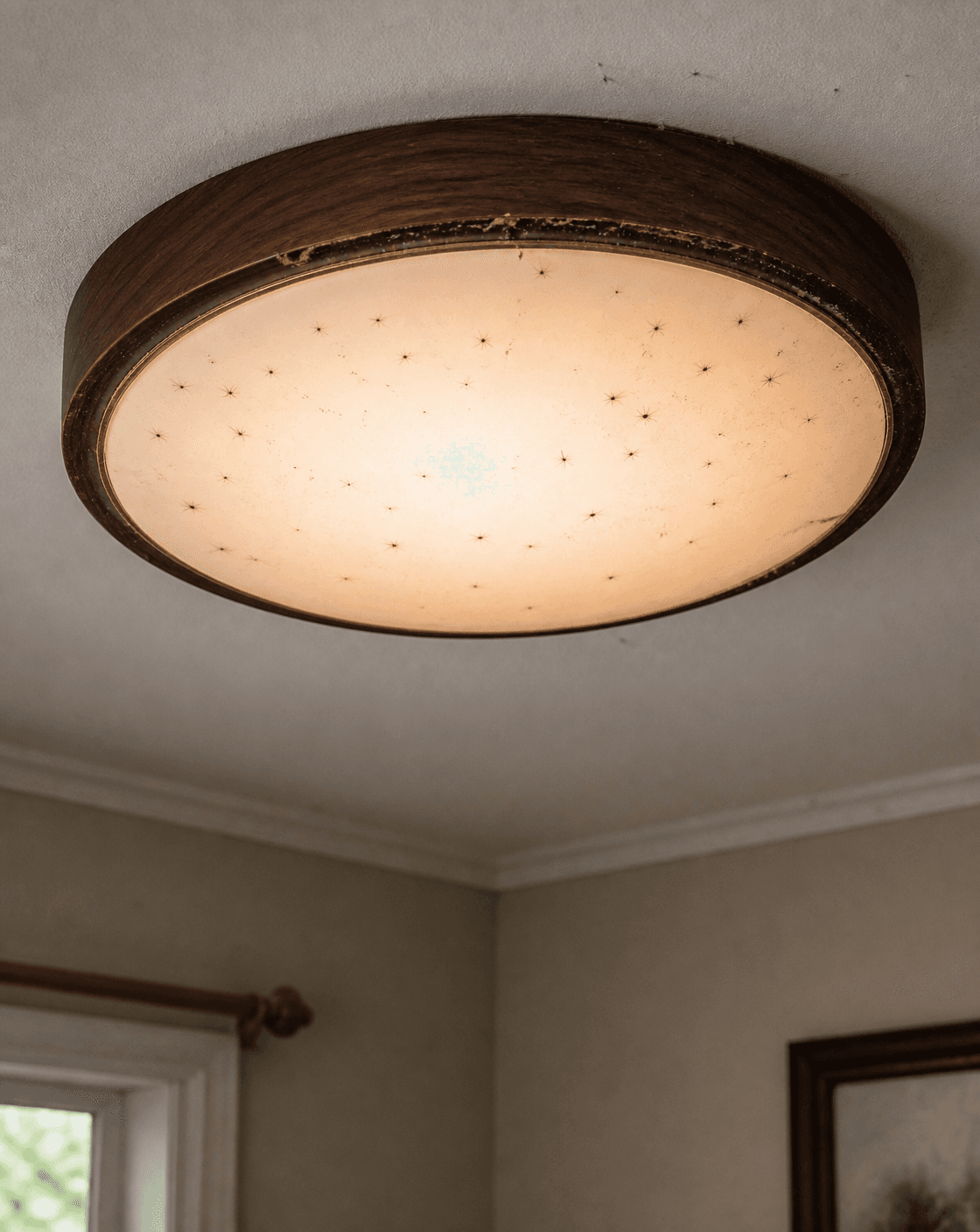
Why Do Bugs Get Inside Ceiling Lights?
Have you ever installed a new ceiling light, only to find small flies, moths, or other insects trapped inside the diffuser a few weeks later?
This is a surprisingly common problem.
The reason is not always poor cleaning or a bad installation. The structural design of the ceiling light itself can determine how easily insects can enter and become trapped inside.
For buyers, wholesalers, contractors, hotels, restaurants, and lighting distributors, understanding a few basic structural parameters can help avoid this problem before purchasing.
The key areas to check include:
Housing and diffuser gaps
Sealing structure
Diffuser-to-housing connection
Ventilation design
Rear mounting structure
Installation environment
Let's look at them one by one.
1. The Most Important Factor: Gaps Around the Diffuser
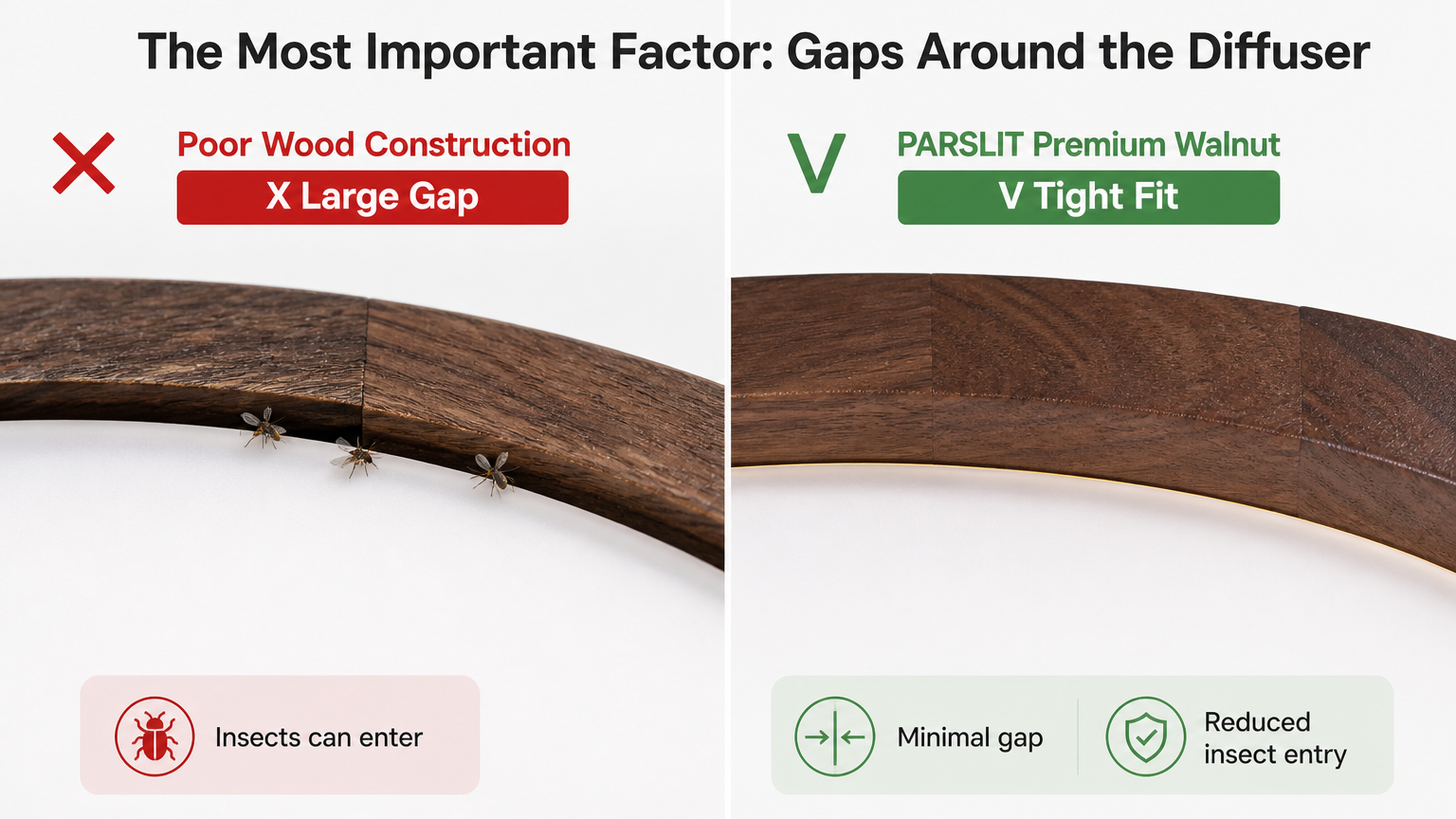
The first place to check is the connection between the light diffuser and the main housing.
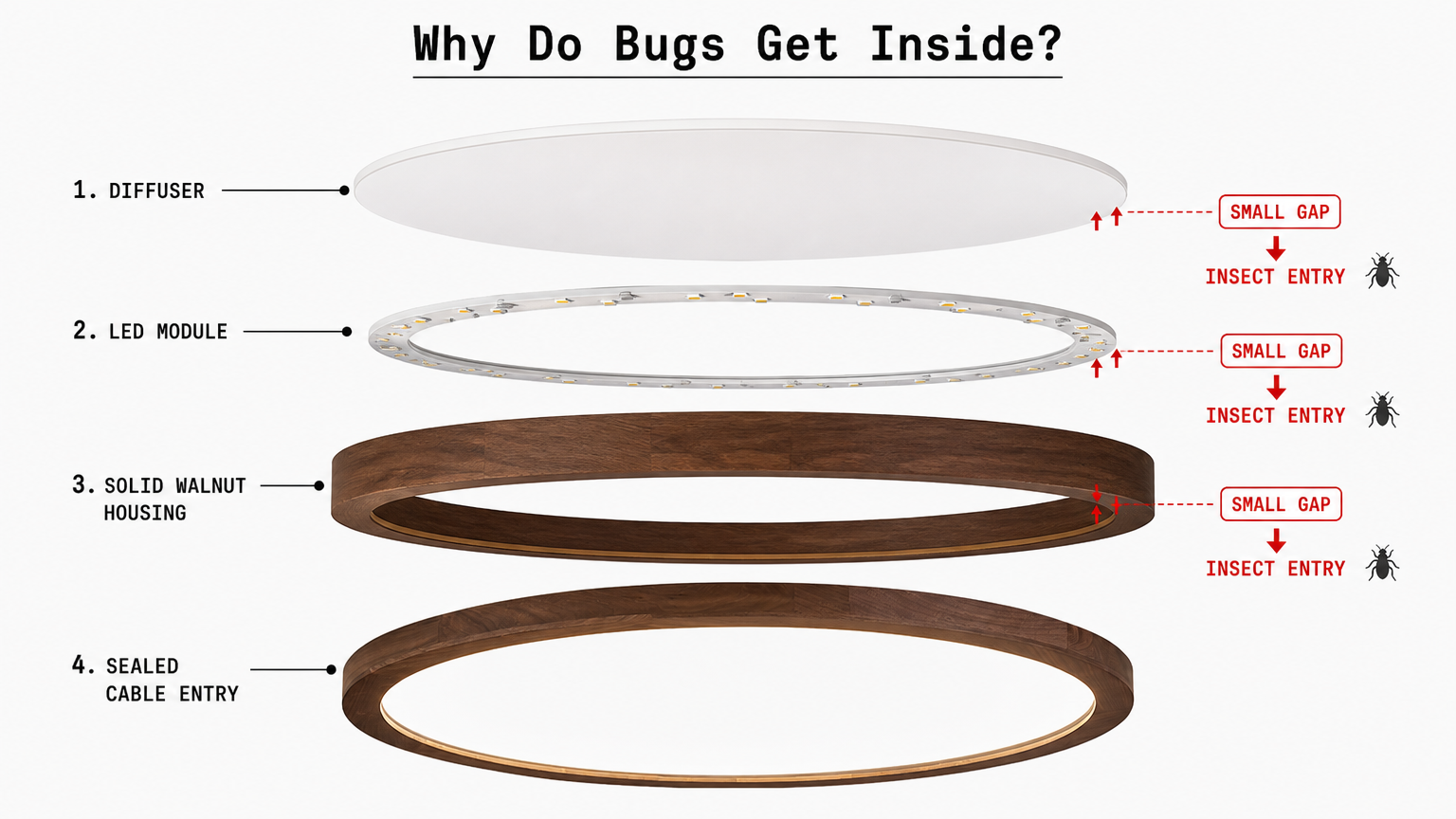
A ceiling light normally consists of several parts:
Ceiling → Housing → LED module → Diffuser
If the diffuser does not fit tightly against the housing, a small perimeter gap may remain.
Even a very small opening can become an entry point for insects, especially when the light is operating at night.
What should you look for?
A better-designed ceiling light should have:
A well-fitted diffuser
Consistent contact around the perimeter
Minimal visible gaps
A stable locking structure
No obvious openings between the diffuser and housing
For residential applications, this can significantly reduce the chance of insects entering the visible lighting cavity.
2. Check How the Diffuser Is Attached
Not all ceiling light diffusers use the same structure.
Common designs include:
Clip-on diffusers
Screw-fixed diffusers
Twist-lock diffusers
Snap-fit structures
Magnetic structures
The important factor isn't simply which fixing method is used.
What matters is whether the connection creates a continuous and stable closure.
For example, a diffuser that relies on several widely spaced clips may leave small gaps between fixing points.
A continuous edge structure can provide better protection against dust and insects.
B2B purchasing tip
When evaluating samples, don't just turn the light on.
Remove and reinstall the diffuser several times.
Check whether:
The diffuser remains firmly attached.
The edge stays evenly aligned.
Any gaps appear after installation.
The housing becomes deformed during assembly.
This is particularly important when purchasing large quantities.
3. Don't Ignore the Back of the Fixture
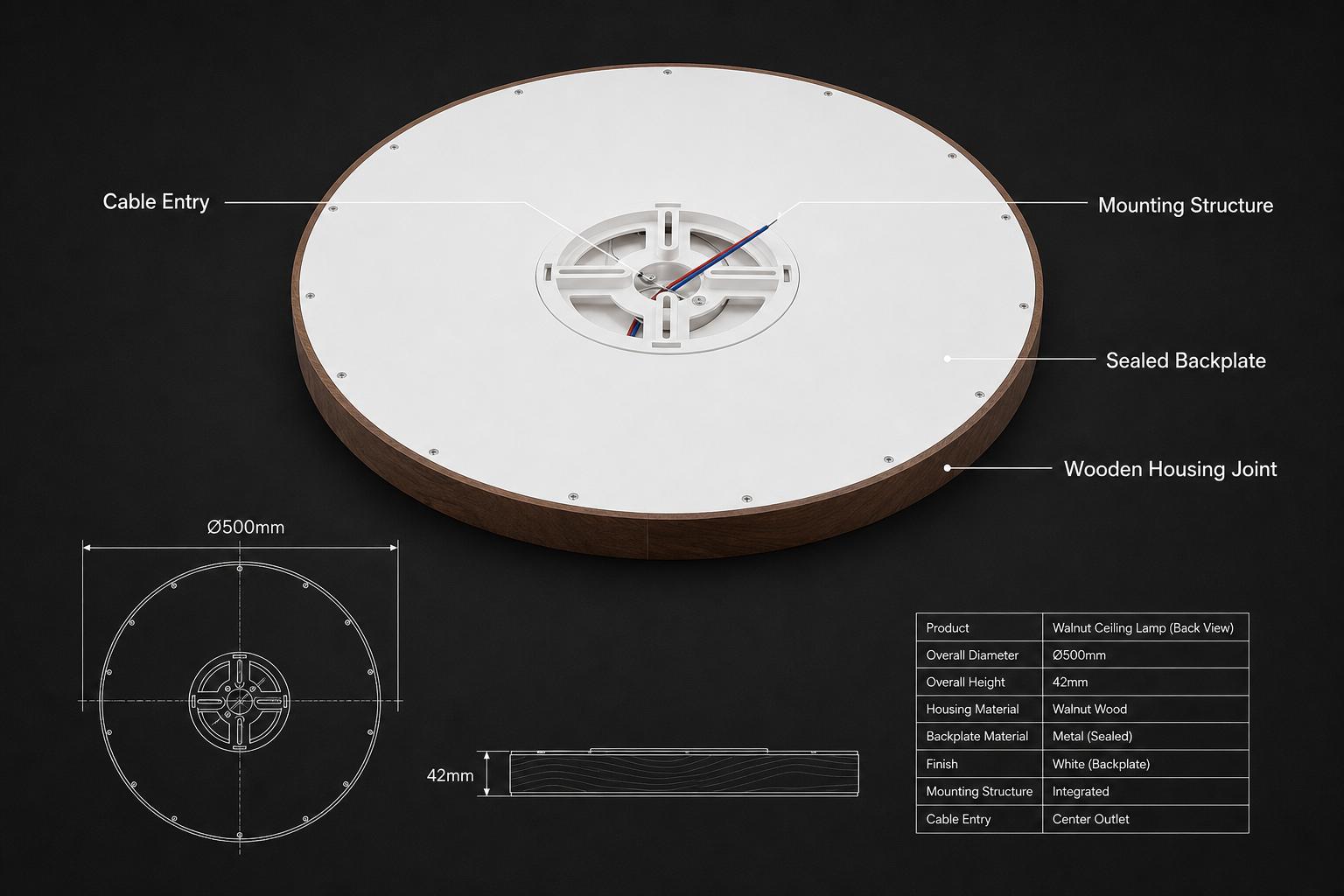
Many buyers only inspect the front of a ceiling light.
But insects don't necessarily enter through the diffuser.
They can also enter through:
Cable entry points
Mounting holes
Junction openings
Driver compartments
Structural gaps on the rear housing
Once inside the fixture, insects may eventually move toward the illuminated area.
For this reason, a well-designed ceiling light should also consider the rear housing structure and cable entry points.
If the product is intended for humid, dusty, or insect-prone environments, these details become even more important.
4. Ventilation vs. Sealing: It's a Design Balance
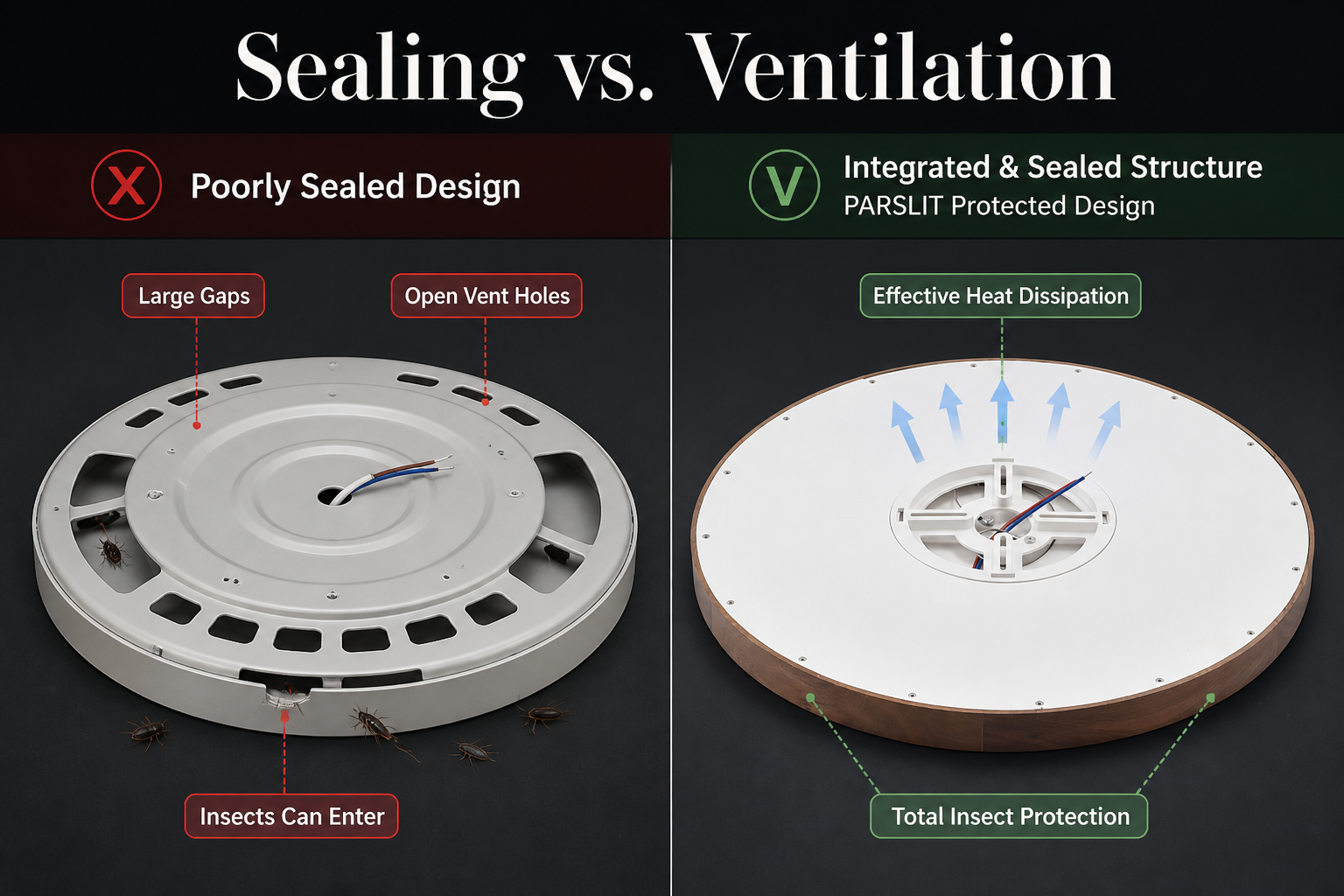
Here's where things get more complicated.
LED ceiling lights generate heat. Therefore, some products require thermal management.
However, ventilation openings can also provide potential entry points for dust and insects.
This creates a design balance:
The light needs enough thermal management without creating unnecessary openings.
Good designs may use:
Heat-dissipating metal housings
Internal thermal paths
Protected ventilation structures
Separated driver compartments
Controlled airflow paths
Instead of simply asking:
"Does this light have ventilation holes?"
A better question is:
"Where are the ventilation openings, and are they exposed to the insect-accessible cavity?"
This is a much more useful question when comparing ceiling light designs.
5. IP Rating Is Important—but Don't Misunderstand It
Many buyers see an IP rating and assume it automatically means the light is insect-proof.
That's not necessarily true.
The IP code primarily describes the enclosure's protection against solid objects and water, under the relevant test conditions.
For example:
IP20 – basic protection against larger solid objects
IP44 – protection against solid objects over 1 mm and splashing water
IP54 – limited dust ingress protection and protection against water splashes
IP65 – dust-tight and protected against water jets
A higher IP rating can indicate a more enclosed construction, but IP rating alone should not be treated as a guarantee that insects cannot enter the optical chamber.
For a lighting buyer, it's better to consider:
IP rating + housing construction + diffuser seal + cable entry + installation environment
as a complete system.
6. Installation Environment Can Make the Problem Much Worse
Even a well-designed ceiling light can attract insects if it is installed in the wrong environment.
Insects are naturally attracted to:
Light
Warmth
Outdoor openings
Food odors
Moisture
This means ceiling lights installed near:
Restaurants
Kitchens
Outdoor entrances
Patios
Gardens
Hotels
Commercial storefronts
may be more exposed to insects than lights installed in bedrooms or offices.
For commercial projects, the lighting structure should therefore be considered together with the surrounding environment.
7. A Simple Checklist Before Buying a Ceiling Light
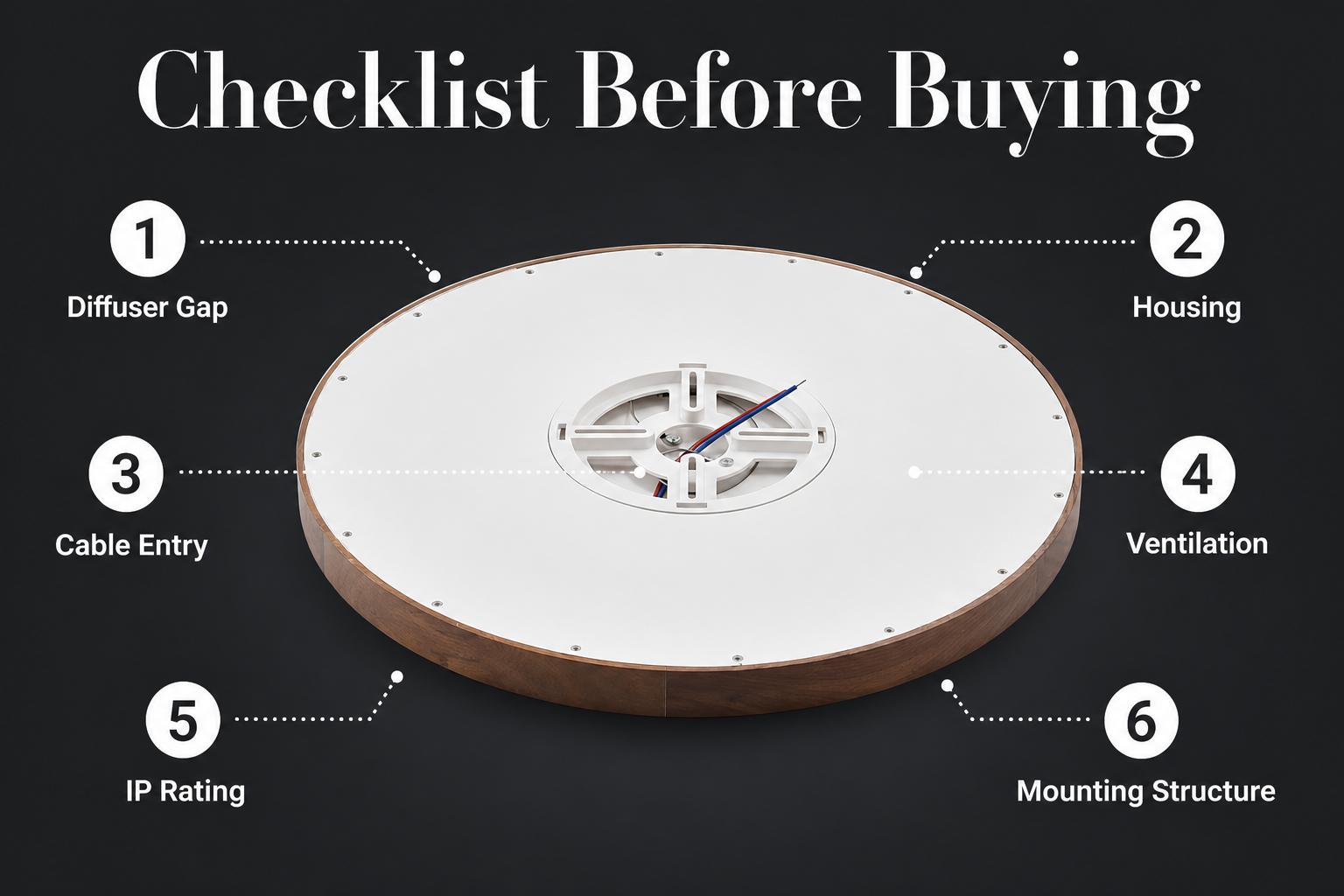
If you want to reduce the risk of bugs getting inside your ceiling lights, check these six points before purchasing:
What to Check | Why It Matters |
|---|---|
Diffuser edge gap | Reduces potential insect entry points |
Diffuser locking structure | Keeps the cover securely closed |
Rear housing | Prevents entry through the back |
Cable entry | Limits openings around wiring |
Ventilation design | Balances heat dissipation and enclosure |
IP rating | Indicates standardized ingress protection |
For B2B buyers, there is one more important step:
Ask for a sample.
Product specifications are useful, but the physical construction tells you much more.
Inspect the diffuser edge, housing joints, mounting holes, driver compartment, and cable entry points before placing a large order.
What Should Lighting Buyers Ask a Manufacturer?
If you are sourcing ceiling lights for a hotel, restaurant, residential project, commercial building, or distribution business, consider asking the manufacturer:
1. What is the IP rating of the complete fixture?
2. How is the diffuser attached to the housing?
3. Are there visible gaps around the diffuser?
4. Where are the ventilation openings located?
5. How is the cable entry sealed or protected?
6. Is the optical chamber separated from the driver compartment?
7. Can the housing or diffuser structure be customized for specific environments?
These questions can reveal much more about product quality than simply asking about wattage and brightness.
Final Takeaway: Don't Judge a Ceiling Light by Appearance Alone
A ceiling light may look completely sealed from the outside, but its internal structure can be very different from one product to another.
If you frequently find insects inside your ceiling lights, the problem may be related to:
Housing gaps + diffuser structure + cable entry + ventilation + installation environment.
Before buying, don't focus only on:
Wattage
Lumens
Color temperature
Appearance
Price
Also look at how the fixture is actually constructed.
For homeowners, this can mean less cleaning and fewer unpleasant surprises.
For B2B buyers, it can mean fewer complaints, better product reliability, and a better experience for the end customer.
At PARSLIT, we focus on practical lighting design for residential, hospitality, commercial, and project applications, with attention to both appearance and structural performance.
Looking for ceiling lights for your next project or wholesale order? Contact our team to discuss your application and product requirements.